
Agricultural Innovation Priorities for 2026 Farm Planning
As 2026 farm planning accelerates, agricultural innovation is moving from optional upgrade to operating necessity. Yield goals, labor shortages, weather volatility, and tighter margins now demand clearer technology priorities.
For modern farm projects, the right agricultural innovation roadmap improves field efficiency, input precision, uptime, and long-term return. It also reduces costly trial-and-error across machinery, data systems, and controlled production assets.
This article outlines practical priorities for 2026. It focuses on smart tractors, harvesting systems, drones, CEA platforms, livestock automation, and the data layer connecting them into measurable performance.
Why agricultural innovation needs a structured 2026 review
Agricultural innovation covers many categories, but budgets and deployment windows are limited. A structured review helps compare options using yield impact, labor relief, interoperability, maintenance burden, and payback timing.
Without a checklist, farms often overbuy features, underinvest in connectivity, or ignore training and service. The result is weak adoption, idle equipment, fragmented data, and disappointing return on capital.
A practical framework also supports cross-sector planning. Mixed operations now blend field crops, protected cultivation, and livestock systems, making agricultural innovation a whole-business decision rather than a single equipment purchase.
2026 priorities that should be checked before investment
- Confirm whether the innovation directly improves yield, harvest speed, input accuracy, animal performance, or water efficiency within one defined production cycle.
- Check machine compatibility with RTK guidance, ISOBUS, telemetry platforms, and existing farm software before comparing horsepower, payload, or greenhouse capacity.
- Measure labor savings realistically, including operator availability, night operation reliability, training time, and service support during seasonal peaks.
- Review total cost of ownership, including fuel or power use, software subscriptions, wear parts, batteries, sensors, and seasonal maintenance downtime.
- Prioritize technologies that convert raw data into action, such as prescription maps, variable-rate application, route optimization, or automated climate response.
- Validate resilience under climate stress, especially for heat, dust, mud, uneven terrain, water scarcity, disease pressure, and unstable field access.
- Check whether local dealers, integrators, or remote support teams can keep critical systems running during planting, spraying, harvest, and livestock feeding windows.
- Compare capital intensity with financing flexibility, expected utilization rate, and the speed at which savings or added output can repay the investment.
Key agricultural innovation areas shaping 2026 farm planning
Smart high-horsepower tractors
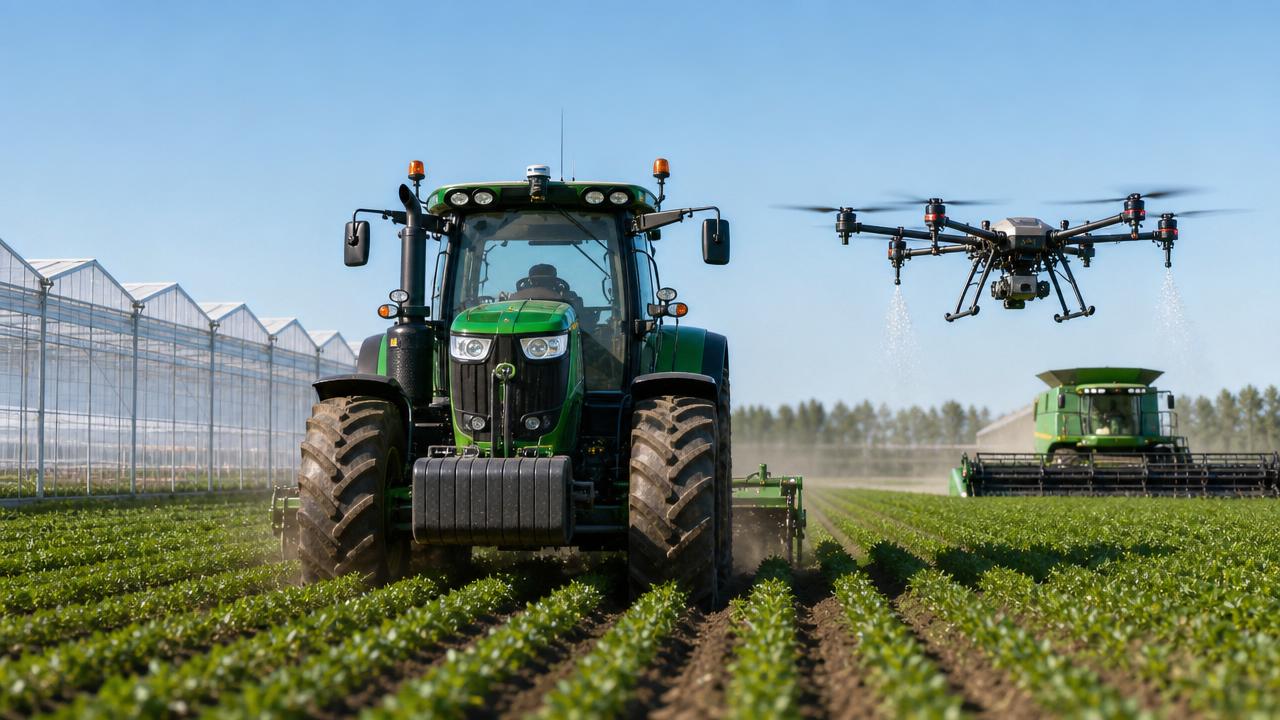
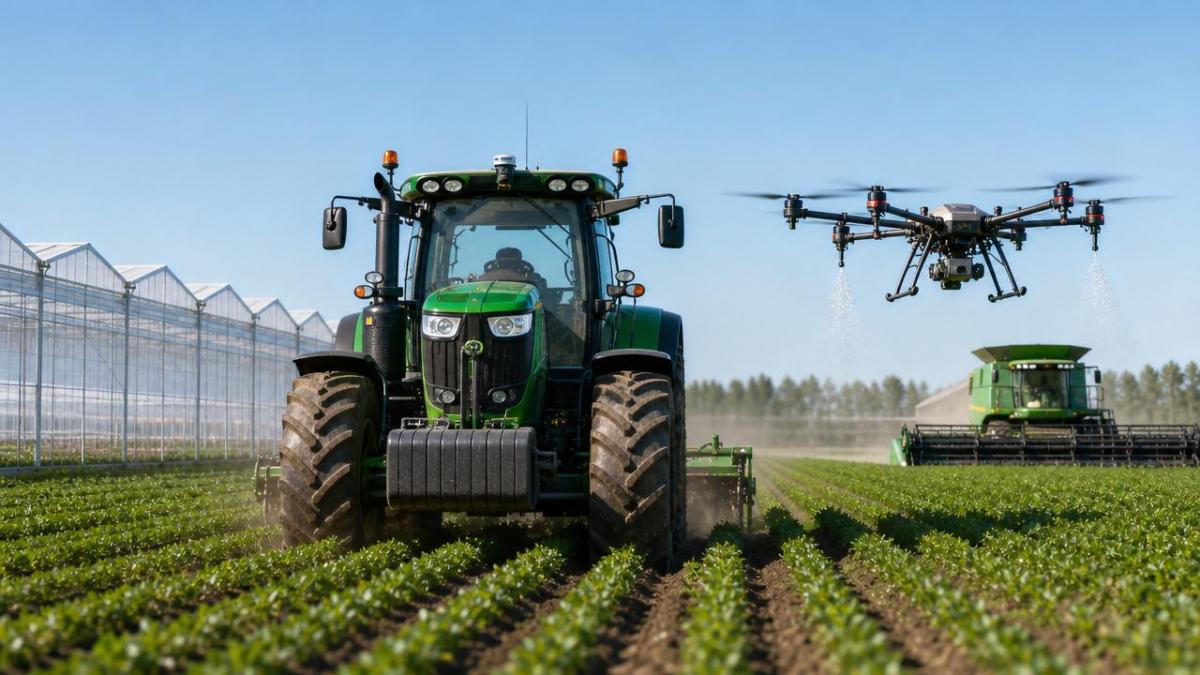
High-HP tractors are no longer just pulling power. In 2026 planning, agricultural innovation means pairing horsepower with RTK autonomy, implement control, fuel efficiency, and data-linked field execution.
The strongest value appears where long working hours, narrow planting windows, and labor scarcity intersect. Straight-line precision, reduced overlap, and nighttime operation create fast, measurable gains per acre.
Combine harvesters and baling systems
Harvest equipment remains a top agricultural innovation priority because revenue depends on timing. Better throughput, grain loss control, moisture tracking, and residue handling directly protect annual output.
Systems with telematics and predictive maintenance reduce stoppages when field conditions are changing by the hour. Baler integration also strengthens residue management and secondary biomass value.
Precision ag-drones
Drone-based agricultural innovation is especially useful where terrain, wet soil, or crop height limits ground access. Modern payloads, terrain following, and targeted spraying improve coverage while reducing compaction.
The best deployments combine drones with scouting, multispectral imaging, and variable-rate decisions. That turns aircraft from a simple spray tool into a data-driven crop intervention system.
Controlled Environment Agriculture systems
CEA is a different form of agricultural innovation, but often one of the most strategic. It stabilizes production through climate control, fertigation, water recirculation, and year-round scheduling.
When fresh produce demand is strong and climate risk is rising, greenhouse systems can improve output consistency, resource efficiency, and planning visibility. Energy economics must be reviewed carefully.
Livestock automation
In dairy and intensive animal systems, agricultural innovation often starts with routine automation. Milking systems, feed mixing, push robots, and vision-based monitoring improve consistency more than headline speed alone.
The most useful metric is not machine novelty. It is whether automation lifts feed conversion, milk yield, animal health response, and labor stability across the entire production calendar.
How priorities change across operating scenarios
Large-scale row crop operations
For broadacre farms, agricultural innovation should begin with autonomy-ready tractors, planter precision, harvest throughput, and telematics visibility. These categories affect the greatest acreage and largest seasonal risk.
Check guidance accuracy, implement matching, fuel performance, and dealer service speed. Gains usually come from reduced overlap, better timing, lower operator fatigue, and fewer unscheduled stoppages.
High-value horticulture and specialty crops
Here, agricultural innovation often centers on precision spraying, greenhouse control, irrigation analytics, and crop health sensing. Quality consistency can matter as much as total yield.
Focus on disease pressure response, labor-intensive tasks, and climate buffering. The right system should reduce waste, improve market-grade output, and protect tight harvest windows.
Mixed crop and livestock farms
Mixed operations need balanced agricultural innovation planning. One-sided investment can leave bottlenecks elsewhere, especially in feed handling, residue use, forage timing, or labor sharing.
Prioritize assets that connect crop output with livestock efficiency. Examples include balers, feed automation, and data systems linking field inventory, ration planning, and equipment utilization.
Commonly missed factors that weaken agricultural innovation returns
One frequent mistake is treating data capture as enough. Agricultural innovation only creates value when field maps, machine logs, and sensor readings trigger actual operational decisions.
Another missed factor is weak interoperability. A high-performance machine can still underdeliver if software, guidance signals, and implement controls cannot exchange clean, usable data.
Service readiness is also underestimated. During planting or harvest, one delayed part or poor calibration can erase expected gains from advanced machinery and smart systems.
Energy, water, and connectivity constraints deserve equal attention. CEA, drones, and automated livestock systems depend on stable infrastructure, not just attractive equipment specifications.
Finally, ROI models often ignore utilization rates. Agricultural innovation should match the number of annual operating hours, hectares covered, or animals managed to justify capital intensity.
Practical steps for 2026 execution
- Rank planned investments by operational bottleneck, not by novelty, and assign one measurable outcome to each technology.
- Run a compatibility audit covering guidance, software, power needs, implement interfaces, and data export formats.
- Pilot one high-impact use case first, then expand after proving uptime, labor savings, and output improvement.
- Build a service plan before purchase, including spare parts access, calibration support, and remote diagnostics availability.
- Track ROI with simple indicators such as acres per hour, input savings, downtime reduction, water efficiency, and quality grade improvement.
FAQ on agricultural innovation for 2026 planning
Which agricultural innovation should be prioritized first?
Start with the system addressing the biggest operational constraint. In many cases, that is field execution, harvest capacity, labor-intensive crop care, or climate-controlled production stability.
How can agricultural innovation ROI be evaluated quickly?
Use a short model based on labor hours saved, input reduction, yield lift, avoided downtime, and quality gains. Then compare that against total ownership cost, not purchase price alone.
Is agricultural innovation only relevant for large farms?
No. The right agricultural innovation depends on production intensity, crop value, and labor pressure. Smaller but specialized operations may gain quickly from drones, CEA, or targeted automation.
Final direction for smarter 2026 planning
Agricultural innovation in 2026 should be treated as a coordinated system decision. The best results come from aligning machinery, automation, agronomy, infrastructure, and data into one practical roadmap.
Begin with a short priority list, validate compatibility, test the highest-impact use case, and scale only after measurable proof. That disciplined approach turns agricultural innovation into durable farm performance.
Related Intelligence