
What can equipment intelligence reveal about machine downtime?
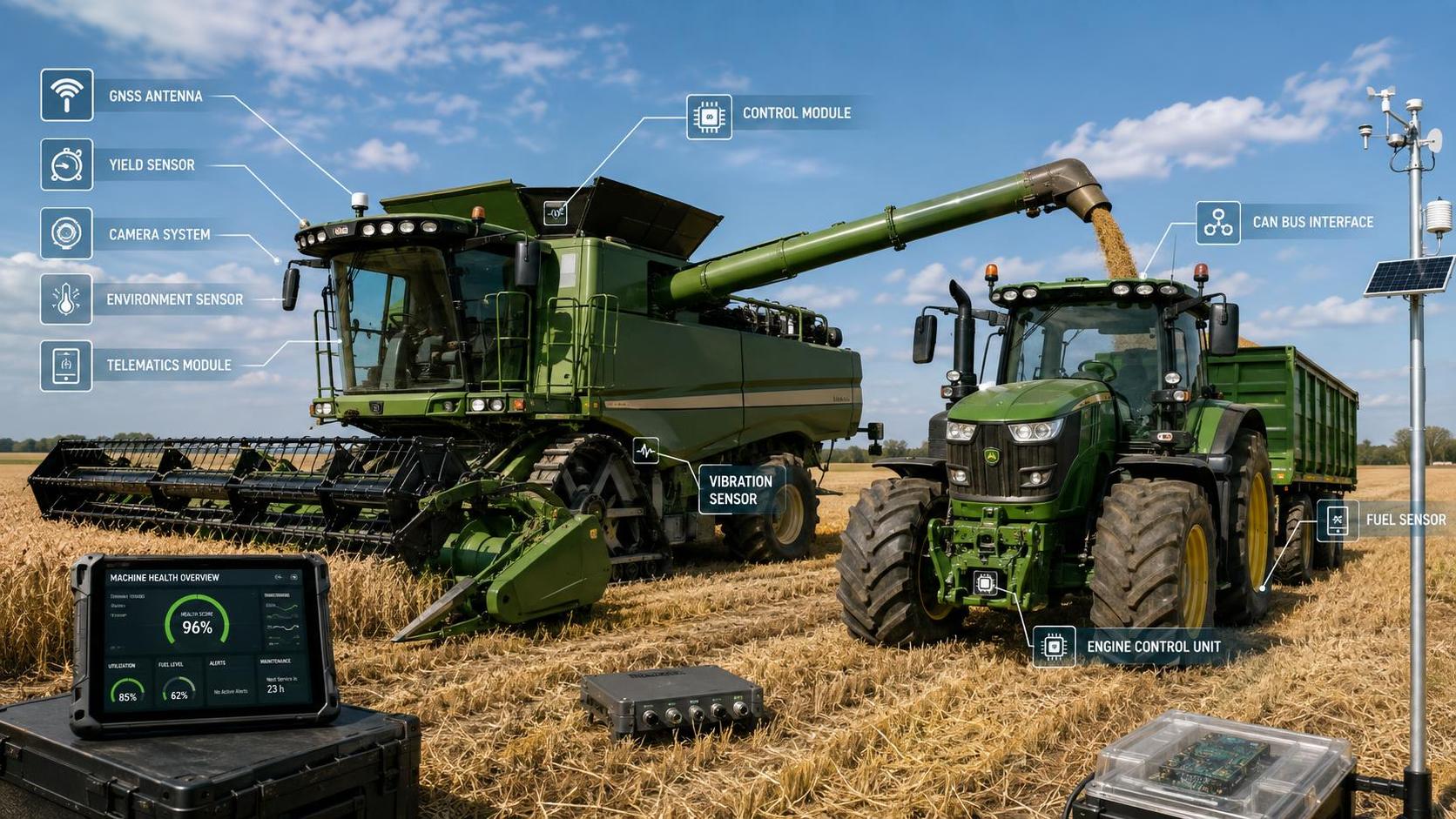
What Can Equipment Intelligence Reveal About Machine Downtime?
Machine downtime is rarely as simple as a failed part. A combine that stops in a narrow harvest window, a high-horsepower tractor that loses power during deep tillage, or a greenhouse fertigation system that goes offline overnight may all present as a single alarm. Yet the alarm is usually the final visible event in a longer chain: rising load, abnormal temperature, repeated operator overrides, delayed service, a weak electrical connection, contaminated fluid, or a component being used outside the conditions it was designed to handle.
That is where equipment intelligence becomes useful. For after-sales maintenance teams, it is not merely a dashboard full of fault codes. Properly used, it connects machine telemetry, controller events, operating conditions, repair records, parts history, and technician observations. The goal is practical: understand why the machine stopped, determine whether the issue is likely to return, and make the next repair more decisive than the last one.
In agriculture, this matters because downtime has a calendar. A tractor can sometimes wait for service after planting, but a combine breakdown during a weather-sensitive harvest can quickly become a crop-quality problem. A failed feeding robot affects labor routines and animal management. A greenhouse climate-control interruption can create risks that are not obvious until crop stress is already visible. Equipment intelligence helps maintenance teams see the operating story behind the breakdown rather than treating every callout as an isolated incident.
Downtime data should answer more than “What fault code appeared?”
A diagnostic trouble code is a starting point, not a root-cause statement. For example, a low-rail-pressure warning on a diesel engine may relate to fuel contamination, a restricted filter, air ingress, a failing sensor, a wiring issue, or a supply problem upstream of the engine. Replacing the component named by the code may clear the warning temporarily without correcting the actual source of failure.
Useful equipment intelligence adds context around the event. Maintenance teams should be able to review what happened before the shutdown: engine speed, torque demand, coolant temperature, hydraulic pressure, PTO engagement, transmission state, battery voltage, ambient conditions, and the sequence of active alarms. On an RTK-guided tractor, it may also be relevant to know whether the fault occurred during autonomous steering, while turning on headlands, or under steady draft load. A drone fleet may need flight logs, battery behavior, terrain-following status, payload condition, and communication events examined together.
The important question is not simply whether an alarm occurred. It is whether the alarm appeared under a repeatable operating pattern. If hydraulic temperature rises only when a baler is working dense, high-moisture material, the maintenance path differs from a machine that overheats during light-duty operation. If a CVT transmission warning appears after long transport runs but not in field work, the investigation should include cooling performance, fluid condition, calibration history, and duty cycle rather than focusing only on the transmission controller.
This distinction is often where the value lies. Equipment intelligence turns an error message into a time-based operating record.
The event sequence often exposes the real failure path
When a machine arrives at a workshop after an interruption, the most valuable evidence may already be gone. Temperatures normalize, intermittent electrical faults disappear, and operators understandably remember the disruption more clearly than the exact sequence. Remote data captured before and during the event preserves details that a post-failure inspection cannot always recover.
A basic event sequence might show a voltage dip, followed by communication errors across several controllers, followed by a transmission warning and engine derate. That pattern points maintenance attention toward power supply, grounding, battery health, alternator output, connectors, or harness integrity. Replacing the transmission-related component in that situation could be expensive and ineffective.
Likewise, a combine harvester may record increased loss-monitor activity, a growing load on the cleaning system, rising engine demand, and then a protective shutdown. The stopping event is not necessarily the failure; it may be the machine protecting itself after material flow became unstable. Header condition, crop moisture, concave settings, sieve settings, feed rate, and operator adjustments can all matter. Maintenance teams do not need to become agronomists, but they do need enough application context to avoid diagnosing normal operating stress as a component defect.
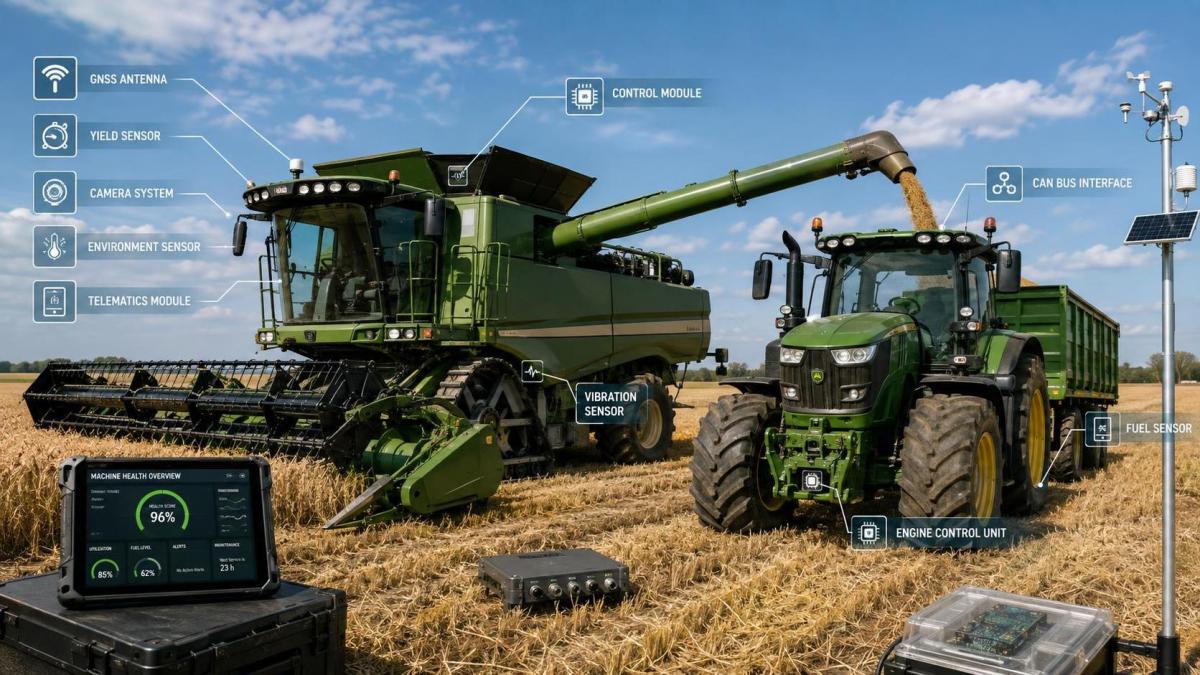
This is particularly relevant for modern agricultural equipment because the boundary between mechanical, electronic, and operational causes is increasingly blurred. A sensor can be accurate but mounted where debris accumulates. A machine vision system can function correctly while its lens is obstructed. A climate sensor can report an anomaly that is actually caused by poor sensor placement, airflow patterns, or a control setpoint that no longer fits the crop stage. The event trail helps separate equipment malfunction from application conditions that require adjustment.
Recurring repairs reveal where the first repair was incomplete
One of the clearest things equipment intelligence can reveal is repetition. A single repair record says little on its own. A pattern across the same machine, fleet, model family, operating region, or component batch can tell a more useful story.
Consider a machine that repeatedly returns with the same hydraulic warning. If the records only list “alarm cleared” or “sensor replaced,” the organization learns very little. If the history also captures hour meter, load profile, oil sampling observations where available, filter condition, previous repair actions, replacement part numbers, and the time between repeat events, the team can begin to assess whether the cause is sensor-related, contamination-related, calibration-related, or connected to a broader hydraulic issue.
Repeat failures also expose weak handoffs. A field technician may repair an urgent fault correctly, but the underlying condition may require a follow-up inspection that never gets scheduled. During harvest, that is understandable: restoring operation comes first. But equipment intelligence should flag machines that were returned to service with a temporary mitigation, a pending firmware update, an unresolved fluid concern, or a part that has a history of repeat replacement.
The same principle applies beyond field machinery. In a dairy operation, repeated interruptions in automated feeding or milking equipment may be linked to wear items, washdown exposure, inconsistent power quality, network interruptions, or operational routines. In controlled-environment agriculture, recurring pump or valve events may be connected to water quality, filtration practice, line pressure behavior, or control logic. The useful insight is not “this asset has many alarms.” It is “these alarms occur after this sequence, in these conditions, and previous repairs have not broken the pattern.”
Not every alert deserves the same response
A common mistake is treating all alerts as equally urgent. That overwhelms technicians and makes genuinely critical warnings easier to miss. A better approach is to prioritize downtime risk, not alarm volume.
For each alert type, teams can ask a few practical questions: Does it trigger a protective shutdown? Has it occurred repeatedly in a short period? Is the machine entering a time-critical operation such as planting, spraying, or harvest? Does the fault affect safety, steering, braking, PTO control, autonomous operation, or livestock welfare? Is there evidence of a worsening trend rather than a one-time deviation?
Prioritization should still leave room for technician judgment. A low-severity alert on a machine heading into a remote field campaign may deserve more attention than the same alert on equipment parked near a well-stocked dealer workshop. Data can rank risk, but it cannot fully understand local access, operator capability, weather pressure, crop maturity, or spare-parts lead time unless those realities are incorporated into the service process.
The most useful intelligence combines machine data with human notes
Telematics alone is not enough. A technician’s note that a connector was wet, a harness was rubbing against a bracket, a hydraulic line was recently disturbed, or an operator reported unusual noise before the fault can be more valuable than dozens of raw data points. The problem is that these observations are often stored in free-text job cards and never connected back to machine history.
Maintenance organizations get better results when service records are structured around a few consistent fields: reported symptom, confirmed fault, observed contributing condition, repair performed, parts used, calibration or software action, and recommendation for follow-up. The wording does not need to be bureaucratic. It simply needs to make later comparison possible.
This is also where a professional intelligence framework becomes more valuable than a simple fleet map. Platforms covering tractors, combines, balers, precision spraying drones, irrigation systems, greenhouse controls, and livestock automation need to recognize that service logic differs by asset type. A PTO-related interruption is assessed differently from a drone battery fault. A fault in a rotary milking parlor may demand a different escalation path from a remote guidance signal issue. Still, the underlying discipline is consistent: preserve evidence, connect events, document repair quality, and look for recurrence.
What equipment intelligence cannot tell you on its own
There is a temptation to assume that more connected equipment automatically means better diagnostics. It does not. Poor sensor quality, missing data, incorrect timestamps, inconsistent machine configuration, and weak maintenance records can produce confident-looking but unreliable conclusions.
A diagnostic model may identify a likely pattern, but it cannot confirm whether a hose is internally damaged, whether contamination is present, whether a connector pin is loose, or whether a mechanical adjustment was performed correctly. Physical inspection remains essential. So does understanding the machine’s actual task. A tractor operating a heavy implement in difficult soil conditions should not be evaluated against the same load expectations as one doing light transport work.
Teams should also be cautious about blaming operators based only on usage data. Repeated high-load events may reflect poor operating practice, but they may just as easily reflect field conditions, an unsuitable implement match, an unrealistic work plan, or equipment that has not been configured for the application. Good after-sales work uses data to start a better conversation, not to assign fault prematurely.
Turning downtime records into a stronger service routine
The practical test of equipment intelligence is whether it changes what happens before the next failure. For maintenance teams, that usually means establishing a repeatable review process around critical machines and seasons. Before planting or harvest, review unresolved alerts, repeat repairs, machines with rising warning frequency, upcoming maintenance intervals, and parts likely to be needed quickly. For greenhouse and livestock systems, the same logic applies around periods when environmental stability or continuous operation is especially sensitive.
It also helps to distinguish between a repair that restores function and a repair that restores confidence. Replacing a failed sensor may restore function. Confirming the wiring route, connector condition, fault history, calibration status, and operating conditions is what builds confidence that the machine will not stop again at the least convenient moment.
For organizations working across modern farm machinery and digital farm systems, the most mature use of equipment intelligence is not predictive maintenance as a slogan. It is a disciplined way to reduce guesswork. It shows which machines deserve attention, which repairs need deeper review, which components fail in context, and where service teams should act before a minor warning becomes a lost working day.
Downtime will never disappear completely from agriculture. Dust, heat, vibration, seasonal pressure, long operating hours, and changing field conditions make that unrealistic. But when the machine’s history is available and interpreted properly, maintenance teams no longer have to begin every urgent callout from zero.
Related Intelligence