
How precision fertigation improves nutrient consistency in hydroponics
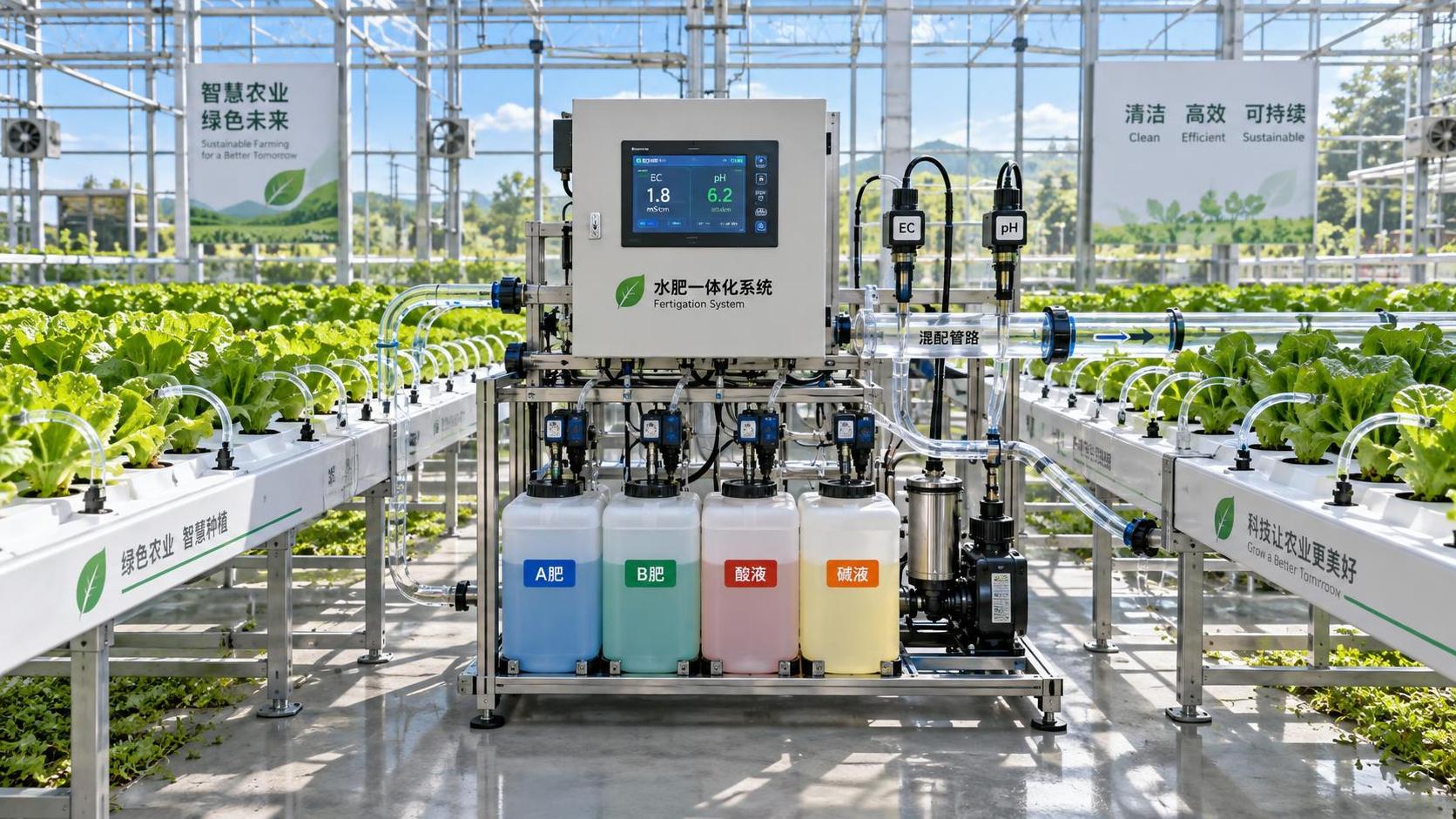
In hydroponic production, nutrient consistency is rarely lost because a grower lacks fertilizer products. It is lost in the small gaps between a target recipe and what actually reaches the root zone: a dosing pump that drifts, uneven pressure across irrigation lines, delayed pH correction, temperature-sensitive stock solutions, or a schedule that keeps feeding after crop demand has changed.
Precision fertigation hydroponics addresses those gaps by treating nutrient delivery as a controlled process rather than a periodic mixing task. Accurate injection, frequent sensing, zone-level irrigation control, and traceable data allow growers to keep electrical conductivity (EC), pH, nutrient ratios, and irrigation volume closer to their intended setpoints. For technical evaluators, the real value is not simply automation. It is the ability to verify whether the fertigation system repeatedly delivers a stable root-zone environment across crops, benches, channels, or greenhouse compartments.
That stability matters because hydroponic crops respond quickly. A slight but persistent shift in nutrient strength may not create an obvious alarm on day one. Over several days, however, it can alter water uptake, leaf expansion, fruit load, calcium transport, or crop uniformity. Precision systems make these deviations visible earlier and provide a practical way to correct them before they become a production-wide issue.
Consistency begins at the injection point, but it does not end there
A conventional fertigation setup may use batch tanks, manually checked EC, and fixed irrigation times. This can work in a small, stable operation with attentive staff. Its limitations become clearer when a site has multiple varieties, changing light conditions, recirculating drainage, large irrigation sectors, or extended operating hours. Manual intervention introduces variability—not because operators are careless, but because the process has too many changing inputs.
Precision fertigation replaces a single “mix and distribute” event with a control loop. Water flow is measured or estimated, fertilizer concentrates are injected at a defined ratio, and the resulting solution is checked against EC and pH targets. The controller then adjusts dosing, acid or alkali addition, and sometimes irrigation duration or pulse frequency. In more advanced installations, it can also account for source-water EC, drain EC, substrate moisture, solar radiation, or crop-stage recipes.
This distinction is important. A stable reading in the mixing tank does not prove a stable delivery at the emitters. Nutrient consistency must be assessed along the full path:
- Source water quality and its seasonal variation
- Stock solution concentration and compatibility
- Dosing pump accuracy across its operating range
- Mixing and reaction time before solution reaches the crop
- Pressure and flow uniformity across irrigation sectors
- Emitter condition, filtration performance, and line flushing
- Root-zone and drain measurements after irrigation
For a technical team evaluating a system, this full-chain view prevents a common mistake: blaming nutrient formulation when the actual cause is hydraulic imbalance or insufficient sensor verification.
EC and pH control: useful indicators, not a complete nutrient analysis
EC and pH are the operational anchors of hydroponic fertigation. EC provides a fast indication of total dissolved ionic concentration, while pH influences nutrient availability, chemical stability, and the risk of precipitation. They are indispensable control variables, yet neither one tells the entire story.
An EC target may be met even when the nutrient balance is wrong. For example, an incorrect calcium-to-potassium ratio can produce an acceptable conductivity value while creating crop-quality risks. Likewise, pH can be within range at the dosing point but change in the root zone due to crop uptake, alkalinity in the source water, microbial activity, or recirculation effects.
A well-designed precision fertigation hydroponics program therefore uses EC and pH as real-time process controls, supported by periodic laboratory analysis of irrigation water, stock solutions, and drainage. The lab data validates the recipe itself; online sensors confirm that the process remains under control between sampling events.
The quality of this approach depends heavily on sensor governance. EC and pH probes require cleaning, calibration, and replacement according to actual water conditions and manufacturer guidance. A neglected sensor can make an automated system less reliable than a careful manual check. Technical specifications should therefore include calibration workflow, alarm logic, sensor redundancy where the risk justifies it, and records showing when each instrument was last verified.
Why pulsed irrigation improves the repeatability of nutrient delivery
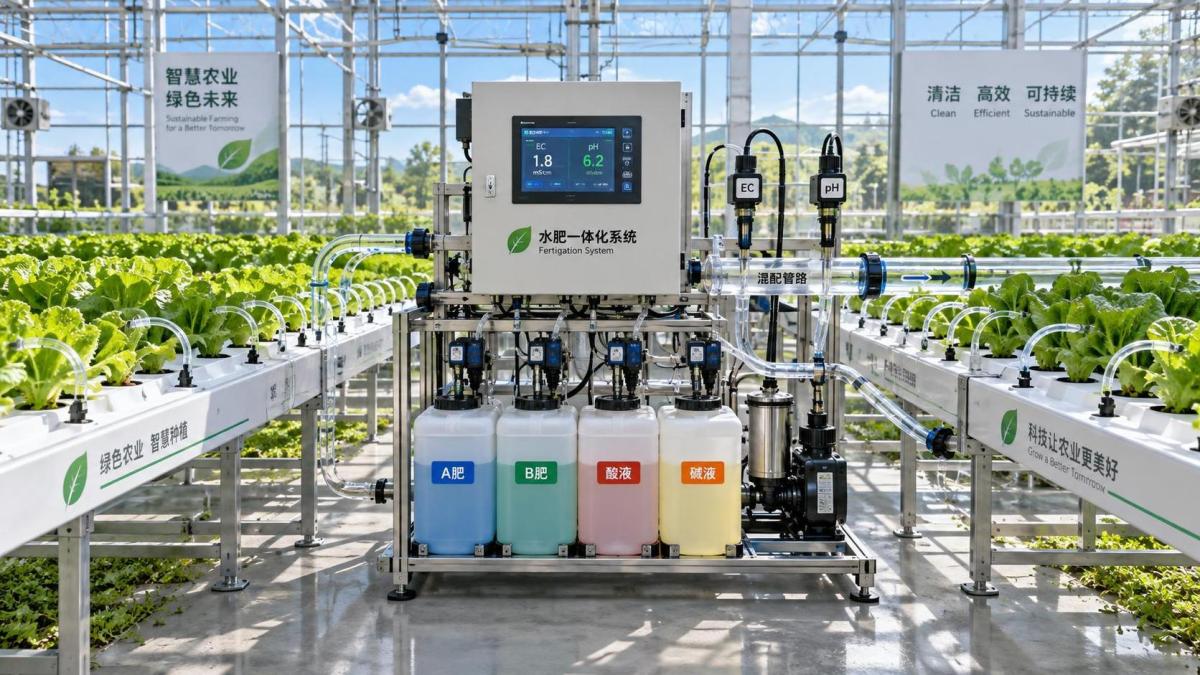
In substrate-based hydroponics, the nutrient solution is only one part of the root-zone equation. The timing and volume of each irrigation event determine how evenly that solution wets the substrate, how much oxygen remains available, and how much drainage carries salts away.
Fixed daily schedules often ignore the fact that crop demand changes hour by hour. On a bright, warm afternoon, plants may transpire rapidly. During a cloudy morning or low-light winter period, the same volume can leave the root zone too wet and dilute. Precision control makes it possible to use shorter, more frequent pulses, triggered by time, radiation accumulation, substrate moisture, weight-based sensing, or a combination of inputs.
Rather than treating every day as identical, the system can apply a recipe that follows crop demand. This improves consistency in several ways:
- Each pulse can be sized to replenish water without excessive leaching.
- High-demand periods receive more timely nutrient solution.
- Dry-back targets can be managed more deliberately overnight or between irrigation windows.
- Drain fraction and drain EC become measurable feedback signals instead of occasional observations.
- Different zones can follow different strategies for cultivars, planting dates, or canopy densities.
There is no universal pulse length or drainage target that suits every crop. Tomato, cucumber, strawberry, leafy greens, and nursery propagation all behave differently, and substrate volume changes the response further. The useful standard is not a generic number; it is whether the irrigation strategy keeps root-zone EC, moisture, and oxygen conditions within an agreed operating band while supporting the desired crop development.
Uniformity is a hydraulic question as much as a digital one
Modern controllers can make sophisticated decisions, but they cannot compensate indefinitely for poor distribution hardware. A greenhouse may show stable EC at the central mixing station while plants at the far end of a lateral receive less water, receive it later, or experience more clogging. The result is uneven nutrient exposure that may appear as inconsistent vigor, variable fruit size, or localized salt accumulation.
Before investing heavily in advanced automation, evaluators should establish the physical uniformity of the irrigation network. This includes pump capacity, pressure regulation, filtration stages, mainline sizing, lateral length, emitter flow variation, return-line design in recirculating systems, and the ability to flush individual zones. Hydraulic design should match not only the total area but also the number of irrigation sectors likely to operate simultaneously.
A practical commissioning test is to collect output from representative emitters across each zone for a defined period, compare volume and EC, and repeat the test under realistic operating conditions. If flow variation is high, the controller may report a perfect recipe while the crop experiences several different recipes.
This is also why zone design deserves attention. Dividing a greenhouse simply by pipe layout can be convenient, but it may not reflect agronomic reality. Zones are more useful when they group plants with similar age, cultivar, substrate, light exposure, and irrigation requirement. Precision fertigation is strongest when the hydraulic map and crop-management map are aligned.
Recirculation changes the control problem
Closed-loop hydroponic systems can reduce water and fertilizer losses, but recirculation adds another layer of nutrient management. Plants do not absorb every ion at the same rate. As drainage returns to the system, the balance of nitrate, potassium, calcium, sodium, chloride, and micronutrients can shift even if EC remains acceptable.
For this reason, a recirculating system should not be controlled solely by topping up to a target EC. It needs defined rules for drain collection, disinfection where appropriate, blending with fresh water, monitoring of accumulated unwanted ions, and partial discharge when thresholds are reached. The appropriate thresholds depend on water source, crop sensitivity, nutrient program, and local discharge requirements.
Technical evaluators should look for a system that can distinguish between feed-water measurements and return-water measurements. Separate data streams make it easier to identify whether an issue originates in fertilizer dosing, crop uptake, root-zone concentration, or recirculation management. In facilities pursuing water efficiency, this traceability is often as valuable as the recovered volume itself.
What to measure when evaluating a precision fertigation system
Procurement decisions can become overly focused on controller interfaces or the number of available sensor ports. Those features matter, but performance should be assessed through measurable outcomes and maintainable operating practices.
A useful evaluation framework includes the following questions:
- Dosing accuracy: Can the injector maintain reliable ratios at low and high flow rates, and how is accuracy verified?
- Response time: How quickly does the system correct EC or pH after a source-water change, recipe switch, or irrigation-zone transition?
- Measurement integrity: Are sensors easy to remove, calibrate, clean, and validate against handheld or laboratory references?
- Hydraulic visibility: Can operators see pressure, flow, valve state, and abnormal irrigation duration by zone?
- Recipe management: Can distinct crop stages and zones be configured without creating an unmanageable number of settings?
- Alarm usefulness: Does the platform distinguish a critical dosing fault from a temporary, non-actionable fluctuation?
- Data access: Can the operation export historical trends for agronomy review, maintenance analysis, and supplier accountability?
- Failure mode: If communication, power, a sensor, or a dosing pump fails, what does the system do and how is staff alerted?
The best system is not necessarily the one with the greatest level of autonomous control. It is the one whose controls match the facility’s crop complexity, staff capability, maintenance discipline, and tolerance for risk.
Common implementation errors that undermine nutrient consistency
One frequent error is automating an unstable baseline. If water quality fluctuates, fertilizer concentrates are poorly stored, filters are undersized, or emitters are already partially blocked, adding a controller will not solve the root cause. Baseline testing should precede automation upgrades.
Another is using EC as the only success metric. Stable EC is encouraging, but crop response, drain composition, irrigation uniformity, and root-zone trends must also be reviewed. A dashboard can look calm while the crop sends early signals of imbalance.
Recipe complexity is a quieter risk. Creating many cultivar-specific formulas may appear precise, yet it can overwhelm operators and increase the chance of configuration errors. Start with a limited set of validated recipes, define who can alter them, and document the agronomic reason behind every significant change.
Finally, teams sometimes underestimate maintenance. Precision equipment depends on clean filters, functioning valves, calibrated sensors, correctly prepared stock tanks, and periodic line flushing. These are not peripheral tasks. They are part of the nutrient-consistency standard.
A more defensible operating standard for hydroponic facilities
For modern greenhouse and controlled-environment agriculture operations, precision fertigation should be evaluated as a system for reducing variation. Its purpose is not to remove agronomic judgment; it gives that judgment more reliable inputs and a faster path to action.
When dosing accuracy, sensor validation, irrigation uniformity, root-zone feedback, and data records work together, nutrient delivery becomes more predictable across the production area. That predictability supports more consistent crop development, clearer troubleshooting, more disciplined use of water and fertilizer, and better confidence in operational decisions.
For technical evaluators, the central question is straightforward: can this fertigation architecture demonstrate that the intended nutrient solution reaches each crop zone, at the right time and in the right volume, repeatedly? If the answer is supported by hydraulic tests, sensor procedures, and interpretable operating data, precision fertigation hydroponics becomes a credible foundation for scalable controlled-environment production.
Related Intelligence