
How agriculture automation improves consistency in field operations
How Agriculture Automation Improves Consistency in Field Operations
Agriculture has always depended on timing, weather, machine condition, and operator judgment. Automation does not remove those realities. What it changes is the amount of variation a farm must accept when the same task is repeated across hundreds or thousands of acres, often under pressure.
That is why the most practical value of agriculture automation is consistency. A tractor can follow the intended pass more accurately. A planter can maintain a more stable application pattern. A sprayer can avoid an overlap that wastes chemical and risks crop damage. A combine can keep operators informed when throughput, grain loss, or moisture conditions begin to move outside a workable range. In each case, the goal is not simply to make equipment look more advanced. It is to make field performance less dependent on who is in the cab, how tired they are, or how difficult the day becomes.
For large farms, contractors, cooperatives, and machinery buyers, this matters because inconsistent operations create costs that are easy to miss. They may appear as uneven crop emergence, missed strips, excessive fertilizer use, compaction in the wrong areas, avoidable downtime, or a harvest that runs too late because the machines were not coordinated. Automation gives managers a better chance of seeing these issues early and repeating a proven process.
Consistency starts with repeatable machine guidance
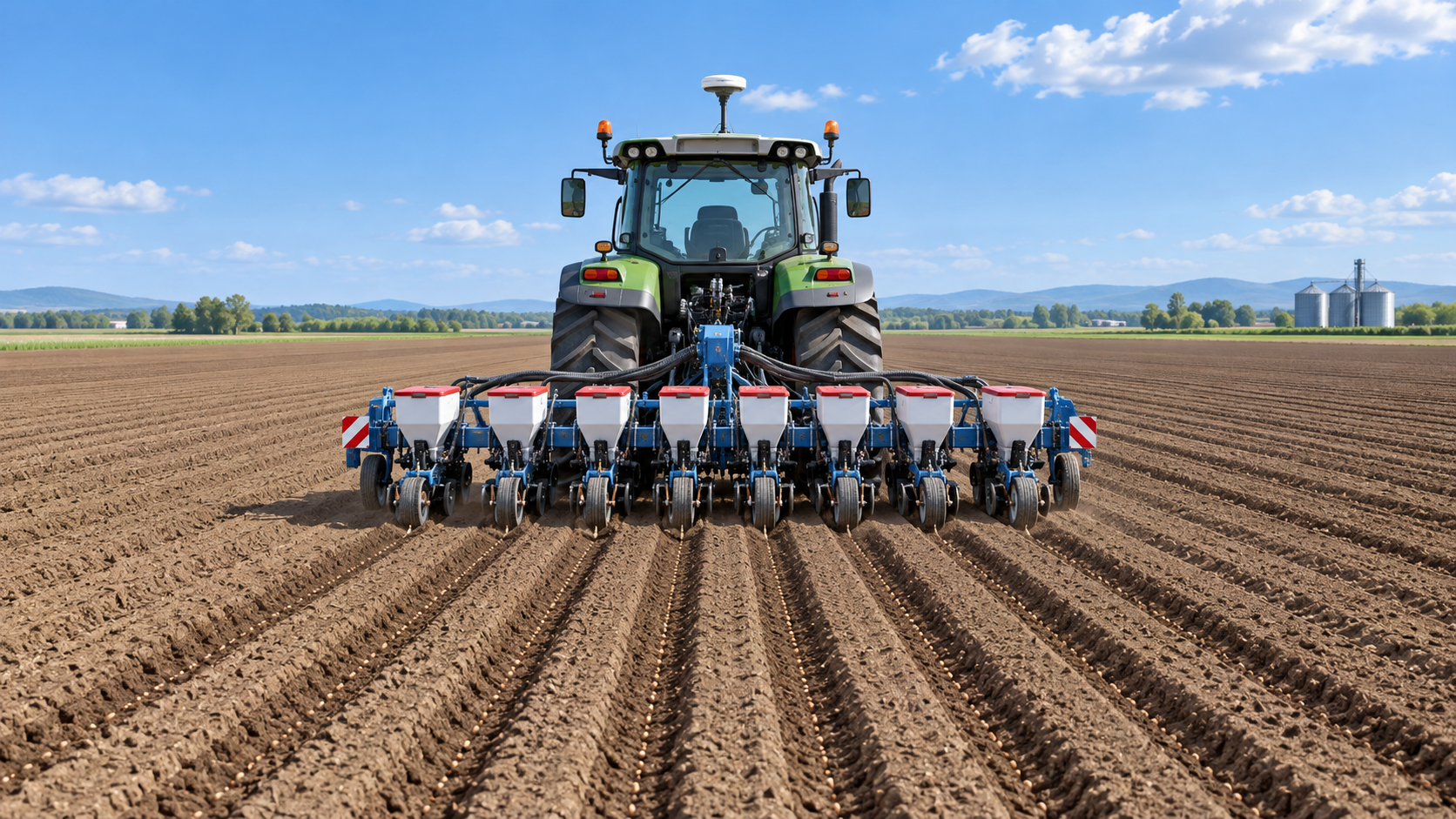
The most familiar entry point is automated steering. RTK-guided tractors and self-steering systems help keep implements on planned lines with a level of repeatability that is difficult to sustain manually during a long shift. This is especially relevant for high-horsepower tractors pulling wide seeders, planters, cultivators, or fertilizer applicators. As implement width increases, even small steering errors can turn into meaningful overlap or skipped ground.
The practical benefit is not limited to straighter rows. Guidance can support controlled traffic patterns, more disciplined headland turns, and better alignment between operations. A planting pass, for example, can establish a reference that is useful later for spraying, mechanical weeding, sidedressing, and harvesting. When equipment follows the same logic from one pass to the next, the farm is less likely to create unplanned wheel tracks or leave irregular treatment zones.
Still, guidance accuracy should not be discussed as though every field receives the same result. Signal availability, terrain, field boundaries, correction services, antenna placement, machine calibration, and implement drift all affect performance. A tractor may hold an accurate line while a long trailing implement moves differently on slopes or in loose soil. Procurement teams should therefore look beyond the steering display and ask how the complete tractor-implement combination behaves in local conditions.
Planting becomes more uniform when machine settings are controlled
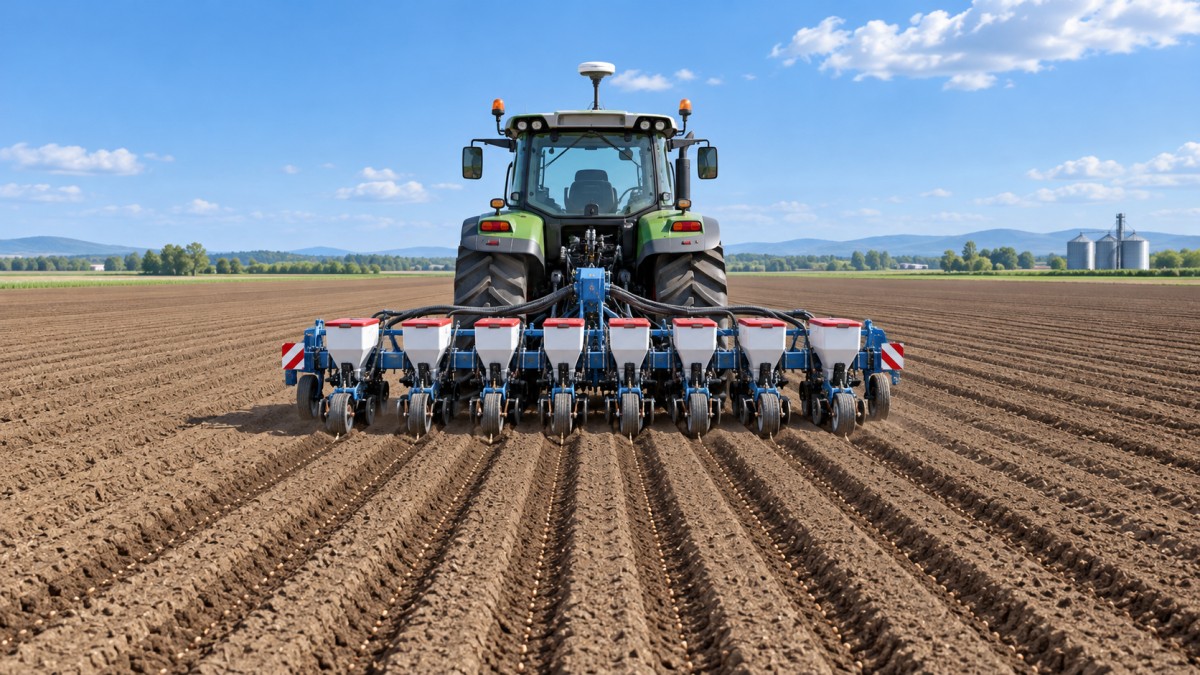
Planting is one of the clearest examples of why repeatability matters. The crop may have only one chance to establish evenly, and a mistake made at planting often remains visible for the rest of the season. Automation can help maintain target populations, row shutoff, section control, depth-related monitoring, and more consistent placement across variable field conditions.
This does not mean a planter can ignore residue, soil moisture, seed quality, or worn components. It cannot. What automation can do is make deviations easier to detect. If downforce, singulation, seed delivery, or row performance begins to differ from the intended setting, the operator or manager has a better chance to respond before an entire field is affected. That is a different value proposition from simply claiming that a planter is “smart.”
Section control is also useful where field shapes are irregular or where headlands contain many point rows. Without it, overlap at the end of passes can lead to excessive seed populations and uneven crop competition. In well-managed systems, the prescription, implement control, and machine position data need to agree with each other. A good map cannot correct a poorly calibrated meter, and a capable planter cannot compensate for inaccurate field boundaries.
Crop care is less variable when decisions are tied to location
Agriculture automation becomes more sophisticated when it connects machine movement to field information. Variable-rate application, prescription maps, crop sensors, multispectral drone imagery, and farm management platforms are all intended to answer a similar question: should every part of this field receive the same treatment?
In many situations, a uniform application rate is operationally simple but agronomically blunt. Soil zones, crop vigor, drainage patterns, previous cropping history, and irrigation coverage can vary sharply within a single field. Variable-rate fertilization or seeding can help match application decisions to those differences, provided the underlying data is reliable and the agronomic recommendation is sound.
The important caution is that imagery is not a decision by itself. An NDVI map may show variation in canopy vigor, but it does not automatically identify the cause. The area could be affected by nutrient availability, compaction, disease, water stress, emergence problems, or a sensor-related interpretation issue. Experienced agronomy teams use maps to prioritize scouting and confirm conditions in the field before changing an input plan.
Spraying offers another useful example. Automated section control reduces unnecessary overlap, while terrain-following functions on precision spraying drones can help maintain a more stable relationship between the aircraft and crop canopy in uneven ground. Yet drone spraying also requires careful attention to payload, battery logistics, wind, droplet behavior, local operating requirements, and refill workflow. The consistency gain comes from a controlled application process, not from replacing every ground sprayer in every situation.
Harvest automation protects short operating windows
During harvest, the main constraint is often time. Weather may narrow the workable window, crop moisture may change quickly, and logistics can become a bottleneck before the combine reaches its theoretical capacity. In this environment, automation helps by making machine performance easier to monitor and adjust while conditions change.
Modern combine harvesters can provide operators with information related to grain loss, throughput, engine load, moisture, and other harvesting conditions. Some systems can assist with adjustments to threshing and cleaning settings. The benefit is not that the machine eliminates operator skill. A skilled operator still needs to understand crop condition, header behavior, residue handling, and the trade-off between speed, grain quality, and losses. What automation can reduce is the delay between a condition changing and the operator recognizing it.
Machine coordination matters as much as the combine itself. If grain carts, trucks, unloading points, and harvest records are disconnected, the field operation may still be inconsistent even with advanced harvesting equipment. Connected platforms can help document where work has been completed, which machine is active, and where delays are recurring. For managers operating several machines, that visibility can be more useful than another isolated dashboard in the cab.
Automation also standardizes work beyond open fields
The same principle applies in greenhouses, controlled-environment agriculture, irrigation networks, and livestock operations. A greenhouse climate control system can maintain temperature, humidity, ventilation, irrigation timing, and CO2-related settings within defined operating rules. Hydroponic fertigation systems can dose water and nutrients more consistently than a manual routine, but sensors, water quality, maintenance practices, and crop-specific recipes still need oversight.
In livestock production, feeding robots, TMR mixers, machine vision, and rotary milking systems can make daily routines more repeatable. A consistent feeding schedule or ration mixing process may support better management decisions because deviations are easier to see. However, livestock automation should never be treated as a substitute for stockmanship. A sensor can flag an abnormal pattern; it cannot replace experienced observation of animal comfort, health, behavior, or facility conditions.
Irrigation automation follows a similar pattern. Soil moisture sensors, weather inputs, flow monitoring, and scheduled controls can reduce guesswork, particularly where labor is stretched across many zones. But poor sensor placement, leaks, clogged emitters, pressure variation, and inaccurate crop assumptions can undermine the entire system. Reliable automation depends on reliable field hardware.
The overlooked side of consistency: maintenance and data discipline
A farm does not become automated simply because it owns connected machinery. Consistency is built through setup, calibration, maintenance, and disciplined use of records. This is where many projects become less impressive than the original equipment demonstration.
Common weak points include outdated field boundaries, incompatible data formats, operators using different machine profiles, sensors that have not been checked, and telematics systems that collect information nobody reviews. A variable-rate controller working from an old prescription map can apply inputs consistently in the wrong place. A guidance system with poorly maintained offsets can repeat an error very accurately. Automation makes process quality more visible, but it can also repeat poor process design at scale.
For this reason, equipment selection should begin with the operation that needs stabilizing. Is the immediate issue planting overlap, labor availability during spraying, uneven irrigation, harvesting delays, or poor visibility across a fleet? The answer determines whether the next investment should be RTK steering, implement control, a drone workflow, better sensors, a farm management platform, or simply a more reliable machine and maintenance plan.
What to evaluate before investing
A sensible evaluation of agriculture automation usually goes beyond advertised capability. Buyers should consider a few operational questions:
- Which field task currently produces the most costly variation or delay?
- Can the existing tractors, implements, sensors, and software exchange usable data?
- Who will calibrate the system, train operators, and troubleshoot problems during peak season?
- Does the proposed workflow still work with local terrain, connectivity, crop mix, labor practices, and service access?
- What records will be used to verify that the new system improved the operation rather than merely added another data source?
This is particularly relevant for farms considering high-horsepower tractors, CVT-equipped machines, autonomous steering, combines, precision drones, greenhouse controls, or livestock automation. The capital cost is only part of the decision. Integration, uptime, dealer support, spare parts, operator acceptance, and the ability to use the resulting data all influence the real return.
Industry intelligence platforms such as Global Smart Agricultural Machinery Systems examine these connections across machinery, digital management tools, crop systems, greenhouse technology, and livestock operations. The useful perspective is not that every farm needs the same technology stack. It is that each automated layer should solve a defined consistency problem and fit the physical operation already in place.
A more predictable operation, not a hands-free farm
The strongest case for agriculture automation is practical: it helps farms repeat good work more reliably. Guidance reduces avoidable variation in machine paths. Implement control improves application discipline. Sensors and connected platforms make deviations easier to identify. Automated climate, irrigation, feeding, and harvesting systems can keep critical routines closer to plan when labor and weather are under pressure.
But the technology works best when it is treated as an operating system rather than a collection of features. Start with the task where inconsistency is already costing time, inputs, quality, or yield potential. Confirm that the machine, data, people, and service support can work together. That approach is less glamorous than buying the most advanced option available, but it is usually how automation becomes dependable in the field.
- smart agricultural machinery
- high-horsepower tractors
- combine harvesters
- hydroponic fertigation
- livestock automation
- agricultural machinery
- drone spraying
- variable-rate fertilization
- fertigation systems
- Hydroponic Fertigation Systems
- Feeding Robots
- smart agricultural machinery systems
- agricultural machinery systems
- farm management platform
Related Intelligence