
How greenhouse irrigation automation systems prevent uneven watering
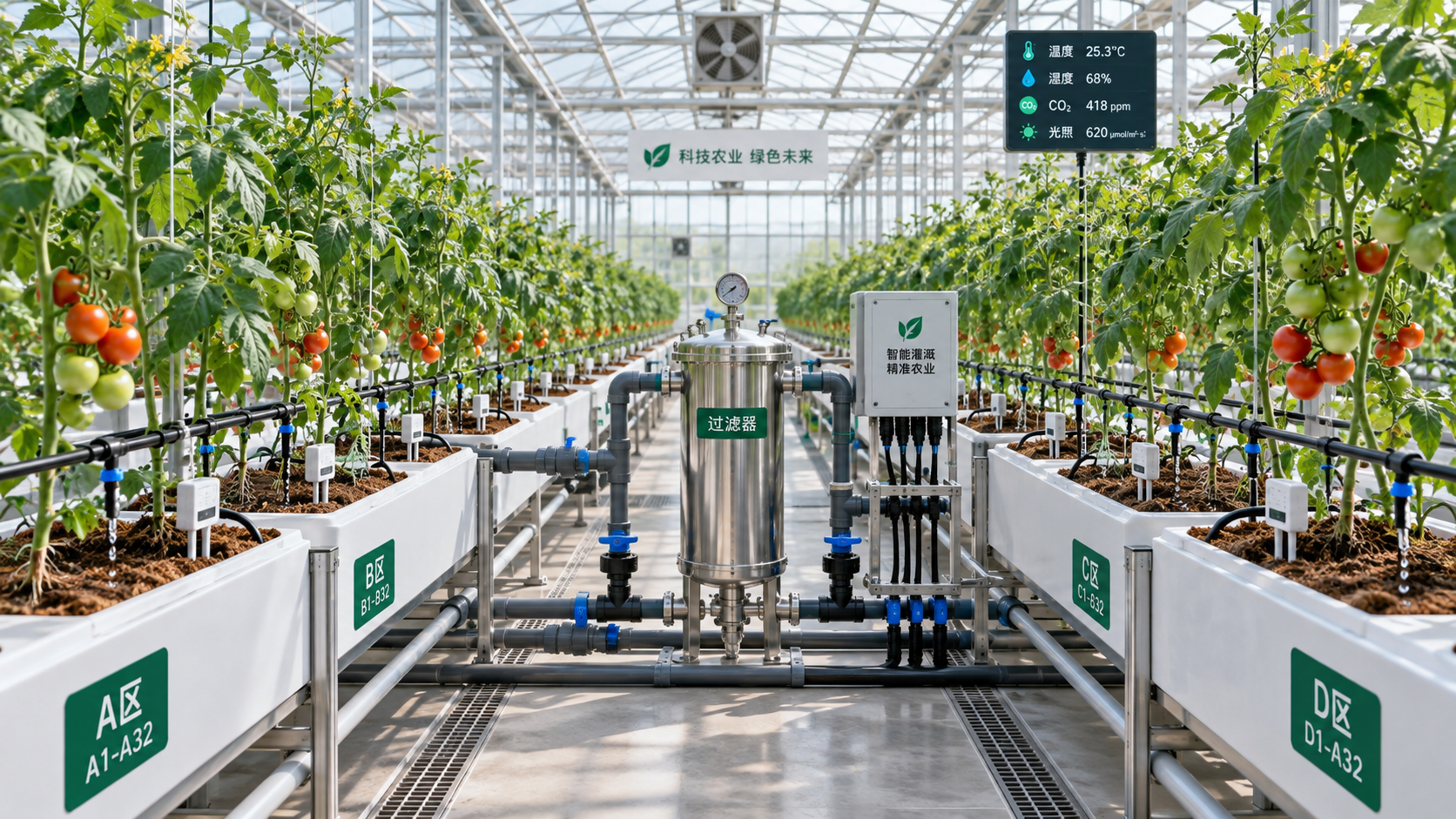
How Greenhouse Irrigation Automation Systems Prevent Uneven Watering
Uneven watering is rarely caused by one obvious failure. In most greenhouses, it develops from small differences in pressure, emitter flow, crop demand, drainage, and operator timing.
An irrigation automation system helps operators control those differences before they become visible crop problems. It combines measured inputs, scheduled actions, zone logic, and alarms into a repeatable process.
For greenhouse teams, the practical goal is not simply to run irrigation automatically. It is to deliver the right volume, at the right time, to each crop zone consistently.
When that happens, plants grow more uniformly, fertilizers are used more efficiently, runoff declines, and operators spend less time correcting avoidable irrigation inconsistencies.
This guide explains how irrigation automation systems greenhouse operators use prevent uneven watering, what problems they can detect, and how to operate them reliably every day.
Why Uneven Watering Develops in Greenhouses
Greenhouses may appear highly controlled, but irrigation conditions can vary considerably from one bench, gutter, row, or substrate bag to another within the same production block.
A long drip line can lose pressure toward its end. If pressure compensation is absent or damaged, plants closest to the manifold may receive more water.
Partially blocked drippers create the opposite problem. A single emitter with mineral buildup, algae, sediment, or root intrusion can leave one plant repeatedly under-watered.
Differences in elevation also affect delivery. Even a modest slope can change line pressure enough to create visible moisture variation in sensitive hydroponic or substrate crops.
Crop variability matters as well. Young plants, mature fruiting crops, shaded rows, edge rows, and plants near ventilation openings do not always use water equally.
Manual irrigation often amplifies these differences. Operators may irrigate a whole house by habit, based on a quick visual inspection, rather than verified moisture or drainage conditions.
Uneven application can also result from poor filtration, inadequate flushing, unstable pump performance, leaking valves, incorrect injector calibration, or incorrectly grouped irrigation zones.
The operational consequence is uneven root-zone moisture. Some plants experience oxygen deficiency from excess water, while others suffer water stress before the next irrigation cycle.
In fertigation systems, inconsistent water delivery also means inconsistent nutrient delivery. This can create uneven crop color, growth rate, fruit size, and harvest timing.
What Irrigation Automation Systems Actually Control
An irrigation automation system is a connected set of controllers, valves, pumps, filters, sensors, injectors, and software rules that manages irrigation without constant manual switching.
Its value comes from using feedback and predefined logic. Instead of applying identical irrigation everywhere, the system can apply different programs to separate greenhouse zones.
A controller typically starts irrigation based on time, solar radiation, substrate moisture, drainage percentage, plant weight, accumulated light, or a combination of these signals.
Solenoid valves open only for the selected zone. This allows different crops, varieties, container sizes, or growth stages to receive separate irrigation durations and frequencies.
Flow meters confirm whether water is actually moving through the system. They help operators identify abnormal flow caused by leaks, broken pipes, blocked lines, or valve faults.
Pressure sensors show whether the hydraulic conditions match the irrigation design. Low pressure may signal filter blockage, pump trouble, or a supply-side restriction.
Fertigation equipment can dose nutrients and acids according to programmed recipes. EC and pH monitoring helps confirm that the intended solution reaches the crop consistently.
Modern systems can log every event, including start time, duration, volume, pressure, EC, pH, drain data, and alarms. This record turns irrigation into a measurable operation.
Automation does not eliminate the operator’s role. It gives the operator better visibility and more consistent execution, provided the equipment is inspected and programmed correctly.
Zone-Based Scheduling Stops One Program From Serving Every Crop
Zone design is one of the strongest defenses against uneven watering. A greenhouse should not treat all plants as identical simply because they share one physical structure.
Each irrigation zone should contain plants with similar crop type, age, substrate volume, irrigation hardware, exposure, and expected water demand whenever practical.
For example, newly transplanted cucumbers require a different strategy from mature fruiting cucumbers. Their root development, canopy size, and daily transpiration are significantly different.
Separating these groups allows operators to use shorter pulses for young plants and more frequent or larger pulses for established plants without compromising either group.
Zones can also separate perimeter rows from central rows. Perimeter plants may face stronger solar gain, drafts, or temperature changes near doors, walls, and roof vents.
A well-configured irrigation automation system greenhouse program can adjust start times and pulse intervals independently, reducing the need for broad manual compensation later.
Zone scheduling is especially useful when multiple crops share one facility. Tomatoes, leafy greens, herbs, ornamentals, and propagation plants should rarely follow an identical watering recipe.
Operators should avoid creating excessively large zones only to reduce installation cost. Oversized zones save hardware initially but limit control and conceal local crop variation.
At the same time, too many zones can make maintenance difficult. The right design balances crop uniformity, hydraulic capacity, labor resources, and controller capability.
Sensor Feedback Helps Operators Water According to Real Conditions
Timers provide consistency, but sensors provide context. A fixed schedule may work on an average day while overwatering during cloudy weather or under-watering during intense sunlight.
Substrate moisture sensors show whether the root zone is drying at the expected rate. They are useful for detecting both persistent excess moisture and insufficient irrigation pulses.
Install sensors in representative locations rather than relying on one convenient point. Include typical plants, high-demand areas, and locations where uneven growth has occurred previously.
Sensor placement matters because readings can be misleading when probes sit beside emitters, outside the active root zone, or in a container that does not represent the zone.
Radiation sensors can trigger irrigation after accumulated light reaches a threshold. This approach often aligns better with plant water use than clock-based scheduling alone.
Temperature and humidity data can support decisions as well. High temperature and low humidity increase transpiration, while cool cloudy conditions may require fewer or smaller pulses.
Drain sensors or drainage collection measurements provide another essential perspective. Too little drain can indicate under-irrigation or uneven distribution, while excessive drain wastes water and nutrients.
Some advanced facilities use weighing systems to measure crop weight changes. These systems can estimate water use precisely, though simpler sensor combinations can still deliver strong results.
Operators should treat sensors as decision tools, not unquestioned authorities. Compare readings with root appearance, substrate condition, drain quality, climate data, and crop response.
Short, Frequent Pulses Improve Root-Zone Uniformity
Many greenhouse crops respond better to multiple controlled irrigation pulses than one large event. Pulsing can wet the root zone more evenly while reducing excessive drainage.
A large irrigation event may saturate the upper substrate first, then push water and nutrients downward before the entire root zone uses them effectively.
Shorter events make it easier to correct for changing weather. When radiation rises quickly, operators can add pulses gradually instead of applying a large safety margin.
Automation allows pulse duration, interval, and daily maximum volume to be programmed separately. These settings create a more controlled response than manually opening irrigation valves.
For substrate-grown crops, the goal is usually to maintain a suitable moisture range while preserving enough air-filled porosity for healthy root respiration.
Pulse frequency should not be copied blindly from another greenhouse. Container size, substrate type, dripper output, crop stage, climate, and drain targets all affect the correct program.
Early-day irrigation typically restores moisture after the overnight dry-down. Midday pulses support peak transpiration, while late-day watering should be managed carefully to avoid excessive night moisture.
Automation can also prevent overlapping zone events that reduce system pressure. Hydraulic capacity must be checked before allowing multiple irrigation valves to operate simultaneously.
When pressure drops during concurrent cycles, every zone may receive less water than programmed. This creates unevenness even though the controller reports that irrigation occurred.
Flow, Pressure, and Filtration Monitoring Find Distribution Problems Early
Automation prevents uneven watering most effectively when it detects physical failures, not only when it starts valves on schedule. Flow and pressure monitoring provide that protection.
A flow meter can compare expected water volume with actual volume for each irrigation event. Higher-than-normal flow may indicate a broken lateral, leak, or stuck valve.
Lower-than-normal flow may indicate blocked filters, clogged drippers, a partially closed valve, pump wear, or insufficient source-water supply during peak demand.
Pressure sensors installed before and after filters help reveal rising pressure loss. A growing differential commonly means filtration needs cleaning or backflushing attention.
Pressure at the irrigation manifold can reveal whether the pump and mainline are performing correctly. Pressure near distant laterals may uncover distribution losses within the greenhouse.
Filters deserve routine attention because poor filtration can create gradual, difficult-to-see emitter problems. Operators may first notice the issue as uneven plant size rather than visible blockages.
Automatic filter backflushing can reduce labor, but it must be verified. Incorrect backflush timing, damaged screens, or poorly maintained filters can still compromise uniform delivery.
Regular line flushing removes sediment and biological material from laterals. An automated flushing routine is useful, but operators should confirm that flushing reaches all line sections.
Keeping flow and pressure records makes troubleshooting faster. Instead of guessing why a row is dry, operators can compare current values with normal operating baselines.
Fertigation Control Prevents Water and Nutrient Variability From Overlapping
Watering uniformity and nutrient uniformity are closely connected. If injection timing or concentration varies, plants may receive different fertilizer strengths even when water volumes appear consistent.
Automated fertigation systems regulate nutrient dosing through injectors, dosing pumps, stock tanks, EC sensors, pH sensors, and programmed irrigation recipes.
EC monitoring helps confirm total dissolved nutrient concentration. A sudden EC change can indicate an empty stock tank, injector malfunction, incorrect recipe, or source-water variation.
pH control matters because nutrient availability changes across the pH range. An accurate irrigation volume cannot fully solve crop nutrition problems caused by unsuitable solution pH.
Operators should verify that fertilizer solution reaches the farthest irrigation points. Sampling only near the mixing station may hide dilution or timing issues downstream.
Pre-irrigation and post-irrigation water periods may be needed, depending on the system design. These periods prevent overly concentrated fertilizer solution from remaining in lines between events.
Drain EC and pH measurements show what is leaving the root zone. Comparing input and drain values helps operators adjust irrigation volume and nutrient strategy together.
Excess drainage may reduce salt accumulation, but it also increases water and fertilizer loss. Automation supports measured adjustments instead of relying on routine over-irrigation for safety.
For operators, the key discipline is calibration. Pumps, injectors, sensors, and stock solution mixing must be checked routinely because automated errors can repeat quickly across a crop.
How Operators Should Set Up and Verify an Automated Program
Start with a clear irrigation map. Identify each valve, crop zone, emitter type, line length, flow rate, filter, pressure point, sensor, and drainage collection location.
Measure actual emitter output rather than assuming the label specification remains accurate. Collect water from multiple drippers at the beginning, middle, and end of representative lines.
Use the results to identify low-flow and high-flow areas. Correct hydraulic or maintenance faults before relying on scheduling changes to solve a distribution problem.
Set a baseline program based on crop stage, substrate, climate, and expected daily water use. Begin conservatively, then adjust using moisture, drain, and crop observations.
Establish alert limits for flow, pressure, EC, pH, tank level, and communication loss. Alerts should be specific enough to prompt action without creating routine alarm fatigue.
Check irrigation event logs daily, particularly after program changes. Confirm which zones ran, how long they ran, whether actual flow matched expectations, and whether alarms occurred.
Walk the crop regularly despite having automation. Look for leaf posture differences, dry substrate spots, standing water, uneven plant vigor, dripper discharge, and unusual drainage patterns.
Compare field observations with controller data. When they disagree, investigate the cause instead of immediately changing the program, because faulty sensors can produce misleading recommendations.
Document adjustments and results. A simple log of weather conditions, program changes, drain readings, and crop response helps the next operator make better decisions.
Common Automation Mistakes That Still Cause Uneven Watering
Installing a controller without improving the hydraulic system is a common mistake. Automation cannot compensate fully for severely clogged emitters, undersized pipes, or unstable pressure.
Another problem is using one sensor to control a highly variable zone. One favorable reading can mask dry plants elsewhere, especially in long rows or mixed exposures.
Overriding the automated program too often can also create inconsistency. Manual interventions should be recorded and based on observed conditions, not anxiety about the forecast.
Ignoring maintenance alarms is equally risky. A small flow deviation today may become a major crop-uniformity problem after several days of repeated irrigation cycles.
Operators should not set schedules only by duration. Actual delivered volume depends on pressure, dripper condition, valve performance, and whether multiple zones are running concurrently.
Failing to review drain data can lead to hidden inefficiency. Crops may appear healthy while excessive runoff carries expensive nutrients away from the root zone.
Finally, avoid treating automation as a one-time installation. Crop demand changes through the season, so irrigation recipes must be reviewed as canopy size and climate change.
Conclusion: Automation Creates Consistency When It Is Measured and Maintained
Irrigation automation systems greenhouse operators depend on prevent uneven watering by combining zone control, timed pulses, sensor feedback, hydraulic monitoring, and fertigation verification.
The greatest benefit is not automatic valve operation alone. It is the ability to identify variation early, apply water according to crop demand, and repeat successful practices consistently.
For daily operators, the practical standard is simple: verify actual delivery, monitor root-zone response, maintain filters and emitters, and adjust programs using data rather than assumptions.
When those habits support a well-designed automated system, greenhouse crops receive more uniform moisture, labor becomes more predictable, and water use becomes easier to manage.
Related Intelligence