
Assessing Automation Components in Commercial Layer Cage Projects
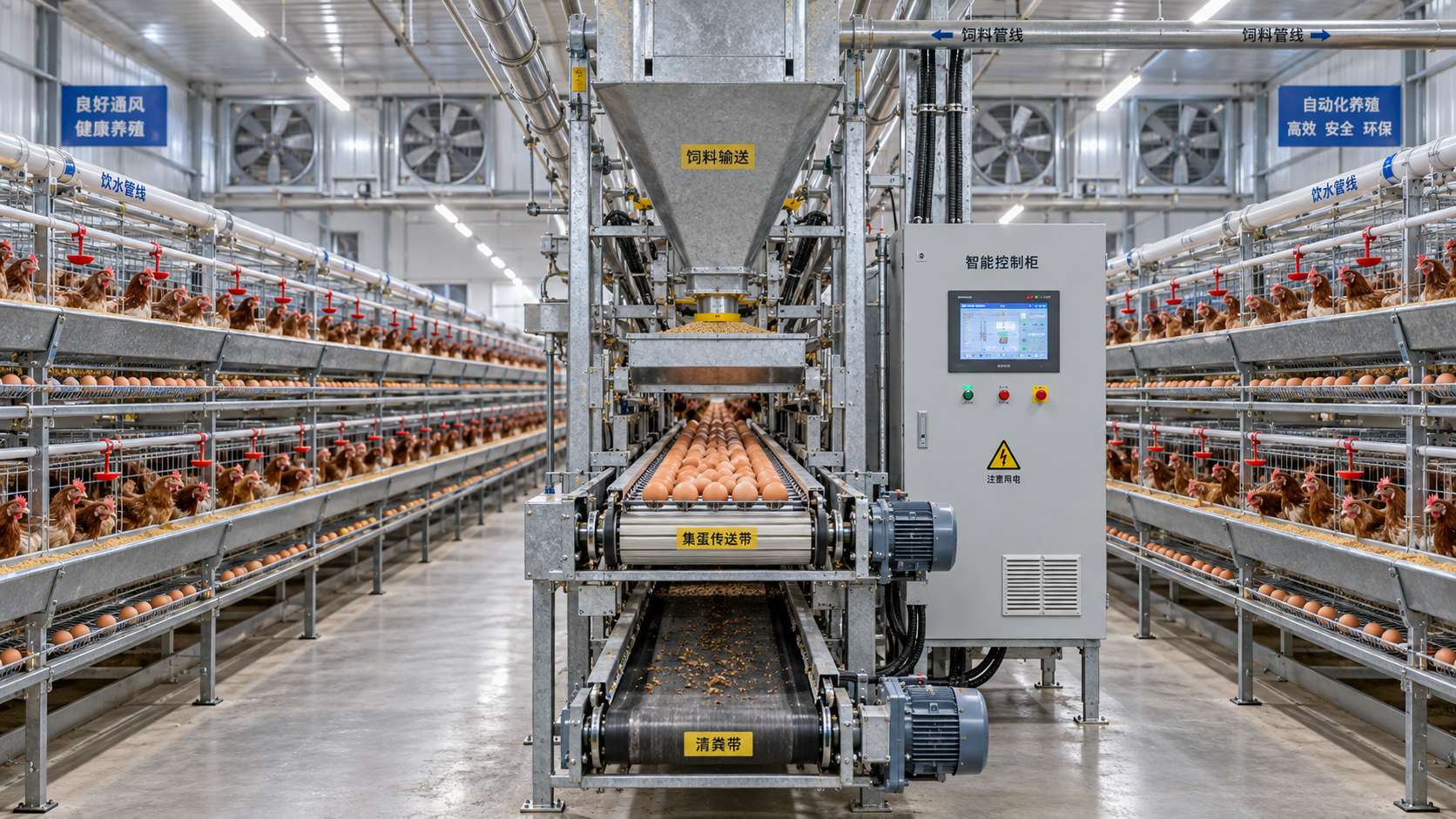
Automation Assessment Starts with the Production Flow, Not the Equipment List
Commercial layer cage projects are often described in terms of visible hardware: cages, feeders, egg belts, manure belts, elevators, controllers, and ventilation systems. For a technical evaluator, that list is only a starting point. The more important question is whether the components form a coordinated operating system under the site’s actual flock size, building geometry, labor availability, utility reliability, hygiene regime, and maintenance capability.
A cage house can contain automated subsystems while still creating manual bottlenecks. An egg belt may carry eggs efficiently to the end of a row, for example, but the benefit is limited if the transfer point, cross conveyor, elevator, packing interface, or cleaning access is poorly matched. Likewise, automated feeding does not resolve uneven feed distribution if hopper sizing, auger routing, trough leveling, or controller timing is not verified against the layout.
The technical assessment should therefore follow the material and animal-management flows through the building: feed entering the house, water reaching drinker lines, eggs moving from cages to collection, manure leaving the building, and environmental controls responding to changing conditions. Every handoff between systems is a potential source of delay, contamination, bird stress, mechanical wear, or unsafe intervention.
Map the Interfaces Before Comparing Individual Components
Layer-house automation is best evaluated as a chain of dependent functions. A component that performs well in isolation may be unsuitable when installed with incompatible controls, unsupported electrical loads, or an awkward building arrangement. The evaluation team should request a layout that identifies drive locations, service aisles, transfer points, electrical panels, water connections, feed-storage interfaces, manure discharge points, and emergency-access routes.
Particular attention should be paid to the interfaces below.
- Feed storage to distribution: The bin outlet, conveying path, hopper capacity, feed level sensing, and row-feeding mechanism should be compatible with the planned feed form and daily operating schedule. Bridging, moisture exposure, and feed segregation can affect system reliability even when the drive equipment is correctly sized.
- Water source to drinker lines: Pressure regulation, filtration, medication compatibility, flushing arrangements, and drainage points matter as much as the nipple drinkers themselves. A layout without practical line flushing can make routine water-quality management more difficult.
- Cage rows to egg handling: Egg belts must maintain stable tracking and transfer eggs gently at changes in direction or elevation. Collection speed, row length, belt tensioning access, and the arrangement of end-of-row transfer points need review together.
- Manure removal to discharge: Belt travel, scraper arrangement, discharge geometry, and access for cleaning should be examined as one system. A manure belt that is easy to operate but difficult to clean at the discharge end may create a recurring sanitation and labor issue.
- Control system to utilities: Controllers, motors, sensors, alarms, and backup provisions depend on reliable power distribution. The electrical design should identify circuit protection, isolation points, motor starting loads, grounding arrangements, and the operating condition during power loss.
Component interfaces become more important as automation density increases. A partly automated house may tolerate a manual workaround for a short period. A heavily automated house can become operationally constrained when one transfer conveyor, sensor, or control circuit is unavailable.
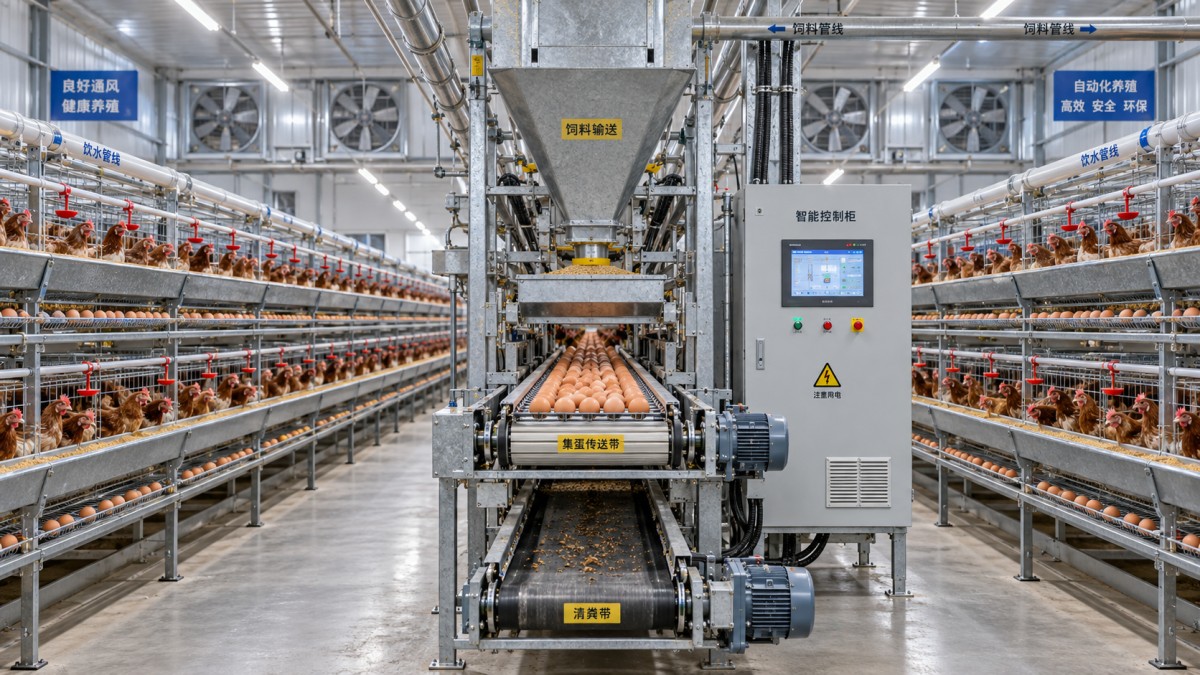
Feeding Automation: Assess Uniformity, Access, and Failure Recovery
Automated feeding is often assessed by asking whether it reduces labor. That is too narrow. The relevant engineering questions concern delivery consistency, adjustability, access for inspection, and the consequences of a stopped feed circuit.
In cage installations, feed distribution equipment needs to deliver feed consistently along the planned row length while allowing operators to observe feed flow and adjust settings. The evaluator should inspect the relationship between feeder drive position, hopper replenishment, trough geometry, cage tier arrangement, and the expected feeding sequence. Long routes and multi-tier arrangements can increase the consequence of an obstruction or incorrectly adjusted drive component.
Consider how the system behaves when it stops halfway through a feeding cycle. Can staff identify the affected line promptly? Is manual operation possible without exposing workers to moving parts? Are there clear isolation procedures before clearing an obstruction? Documentation should distinguish between routine adjustment tasks and interventions that require the equipment to be stopped and isolated.
Feed automation also has a building-design dimension. Bin position affects conveying distance and service access. External equipment should be protected from water ingress and arranged so that delivery vehicles do not interfere with personnel routes or emergency access. These details are not secondary construction matters; they shape everyday reliability.
Egg Collection Requires Gentle Transfers and Maintainable Alignment
Egg collection equipment is a mechanical handling system, not merely a belt installation. Technical review should focus on where eggs accelerate, decelerate, change direction, pass between belts, or enter an elevator. These are the locations where alignment, belt condition, transfer geometry, and speed settings have the greatest effect on shell damage and operational interruptions.
Assess whether each belt can be tensioned, cleaned, and inspected without excessive dismantling. The availability of access space is especially relevant in multi-tier projects, where drives and idlers can be located above normal working height or behind structural members. A well-designed system gives operators a practical way to inspect belt tracking before a minor deviation becomes a recurring collection problem.
Capacity should be assessed as a route-wide condition. A fast longitudinal egg belt does not establish the capacity of the whole system if the cross conveyor or transfer elevator is slower. Evaluators should compare the expected collection window with the rated and practical capacity of each downstream stage, while recognizing that actual performance depends on egg flow patterns, cleaning practices, operator response, and mechanical condition.
Manure Belt Systems Need a Cleaning and Discharge Strategy
Manure removal is sometimes specified late in a project, after cages and egg collection have received most of the design attention. That approach can create avoidable problems. Belt width, belt support, scraper contact, discharge height, access for cleaning, and the route to external storage or treatment all need early coordination.
A technical evaluation should identify where manure accumulates during normal operation and where residue may remain after belt discharge. Sharp changes in conveyor direction, scraper edges, and transfer chutes deserve close inspection. Materials selected for those zones should be appropriate for repeated contact with manure, moisture, cleaning agents, and abrasive particles. Fasteners, joints, and areas beneath belt supports should not create inaccessible debris traps.
The chosen removal frequency should also fit the site’s downstream handling arrangement. Frequent belt operation can reduce residence time inside the building, but it requires dependable drives, predictable discharge handling, and a practical response plan if the external route is unavailable. Less frequent operation may reduce run time but can place different demands on ventilation, cleaning, and manure storage planning. There is no universal interval that suits every house design.
Controls, Sensors, and Power Protection Are Operational Infrastructure
Automation is frequently judged by the presence of a controller. The more useful question is what the controller can verify, what it can only command, and what still requires a person to inspect. A timer can initiate feeding or belt movement; it does not confirm that a feed route is clear, a belt remains aligned, or a water line is functioning as intended unless appropriate feedback devices and operating checks are in place.
Control specifications should state the purpose of each sensor, alarm, interlock, and manual override. An alarm has limited value if staff do not know whether it signals a critical stop, a maintenance condition, or a temporary process variation. Event records can be helpful where available, but they should not replace physical walk-through inspections of belts, drives, cage rows, drinker lines, and ventilation equipment.
Electrical evaluation should include cable routing, enclosure suitability for dust and moisture exposure, isolation points, protection against accidental restart during maintenance, and the status of critical loads under backup power. Machinery electrical equipment is commonly assessed against project-appropriate electrical safety requirements; IEC 60204-1 provides widely used requirements and recommendations for the electrical equipment of machines, although local law and project specifications determine what applies in a particular installation (Source: IEC 60204-1:2016, Safety of machinery—Electrical equipment of machines—Part 1: General requirements).
How a Two-Year Warranty Should Be Read During Technical Due Diligence
A warranty can be relevant to the assessment of automation fit, but its value depends on what is covered, how claims are handled, and which operating conditions may limit coverage. A stated period alone does not indicate whether consumable parts, electrical controls, motors, belts, corrosion-related deterioration, installation errors, or transport damage are included.
When reviewing an equipment configuration described as automatic layer chicken equipment with 2 year warranty, evaluators should treat the warranty statement as one item in a broader verification package. The useful follow-up questions concern the warranty start date, exclusions, required maintenance records, spare-parts availability, remote troubleshooting process, and responsibility for diagnosis, labor, and shipment. These points influence downtime exposure far more directly than the duration stated in a headline.
It is also sensible to separate defects associated with manufacture from failures caused by site conditions. Excessive humidity, corrosive cleaning routines, unstable power supply, misalignment during installation, overloaded equipment, and inadequate preventive maintenance can all affect mechanical and electrical components. Procurement documents should define acceptance tests and installation responsibilities so that later fault investigation does not become an argument over scope.
Procurement Documents Should Convert Expectations into Verifiable Requirements
Technical teams can reduce ambiguity by requesting a component schedule rather than accepting a general description of “fully automatic” operation. The schedule should identify each major subsystem, its location, drive type, control method, service access requirement, and interface with adjacent equipment. It should also distinguish items supplied with the cage package from work to be completed by the civil, electrical, ventilation, or local installation contractor.
Commissioning should include more than a brief demonstration that motors run. A practical acceptance process normally checks direction of travel, belt alignment, tensioning, feed flow, drinker-line flushing, sensor response, alarm logic, mechanical guards, and safe access for routine tasks. Any deviations should be documented before flock placement, when correction is generally less disruptive.
Animal Welfare and Food-Safety Context Cannot Be Separated from Equipment Decisions
Automation does not remove the need for stockperson observation. Equipment can distribute feed, move manure, and collect eggs, but personnel still need to observe bird condition, access to feed and water, equipment-related injury risks, and environmental conditions. The World Organisation for Animal Health describes animal welfare as relating to the physical and mental state of an animal in relation to the conditions in which it lives and dies; its Terrestrial Animal Health Code includes welfare guidance relevant to poultry production systems (Source: World Organisation for Animal Health, Terrestrial Animal Health Code, Chapter 7.10, “Animal welfare and broiler chicken production systems”).
Although a specific project may be governed by local animal-welfare and food-safety rules rather than international guidance, the engineering implication is clear: cage and automation choices should allow regular observation, cleaning, maintenance, and safe intervention. A design that makes inspection difficult can turn a manageable mechanical issue into a flock-management issue.
The strongest commercial layer cage projects are not necessarily those with the longest equipment lists. They are the projects in which feed, water, egg collection, manure handling, controls, utility protection, access, and maintenance procedures have been evaluated as connected operating conditions. That is the level at which automation becomes assessable: not as a promise of labor reduction, but as a system whose performance can be inspected, tested, serviced, and managed through normal farm operations.
Related Intelligence