
Climate-Smart Agriculture Equipment Worth Investing In
Climate-Smart Agriculture Equipment Worth Investing In
For business evaluators, climate pressure has shifted equipment buying from seasonal planning to strategic risk management.
That is why climate-smart agriculture equipment now sits closer to ROI analysis than to optional technology upgrades.
The real question is not which machine looks advanced.
It is which equipment protects output, stabilizes labor, and improves resource efficiency under weather volatility.
From recent market shifts, the strongest signal is clear.
Buyers are prioritizing climate-smart agriculture equipment that delivers measurable savings per acre, per labor hour, and per production cycle.
That includes autonomous guidance, precision spraying, controlled environment systems, smart irrigation, and livestock automation.
Each category addresses a different climate and cost exposure.
The investment case becomes stronger when equipment supports both immediate operating gains and long-term resilience.
Why climate-smart agriculture equipment is moving into core CAPEX
Input costs remain volatile, labor availability is uneven, and weather windows are getting tighter.
In that environment, delayed fieldwork or inefficient input use can destroy margins quickly.
Climate-smart agriculture equipment helps reduce those losses by improving timing, precision, and repeatability.
This also means procurement teams should assess machines as operating systems, not as isolated assets.
A tractor with RTK guidance, for example, changes fuel use, overlap rates, and operator fatigue.
A greenhouse climate platform changes water use, disease pressure, and crop consistency.
The best climate-smart agriculture equipment supports three business outcomes:
- Lower cost per unit of production
- Higher performance during weather disruption
- Better visibility for planning, maintenance, and input control
1. RTK-guided tractors and autonomous steering systems
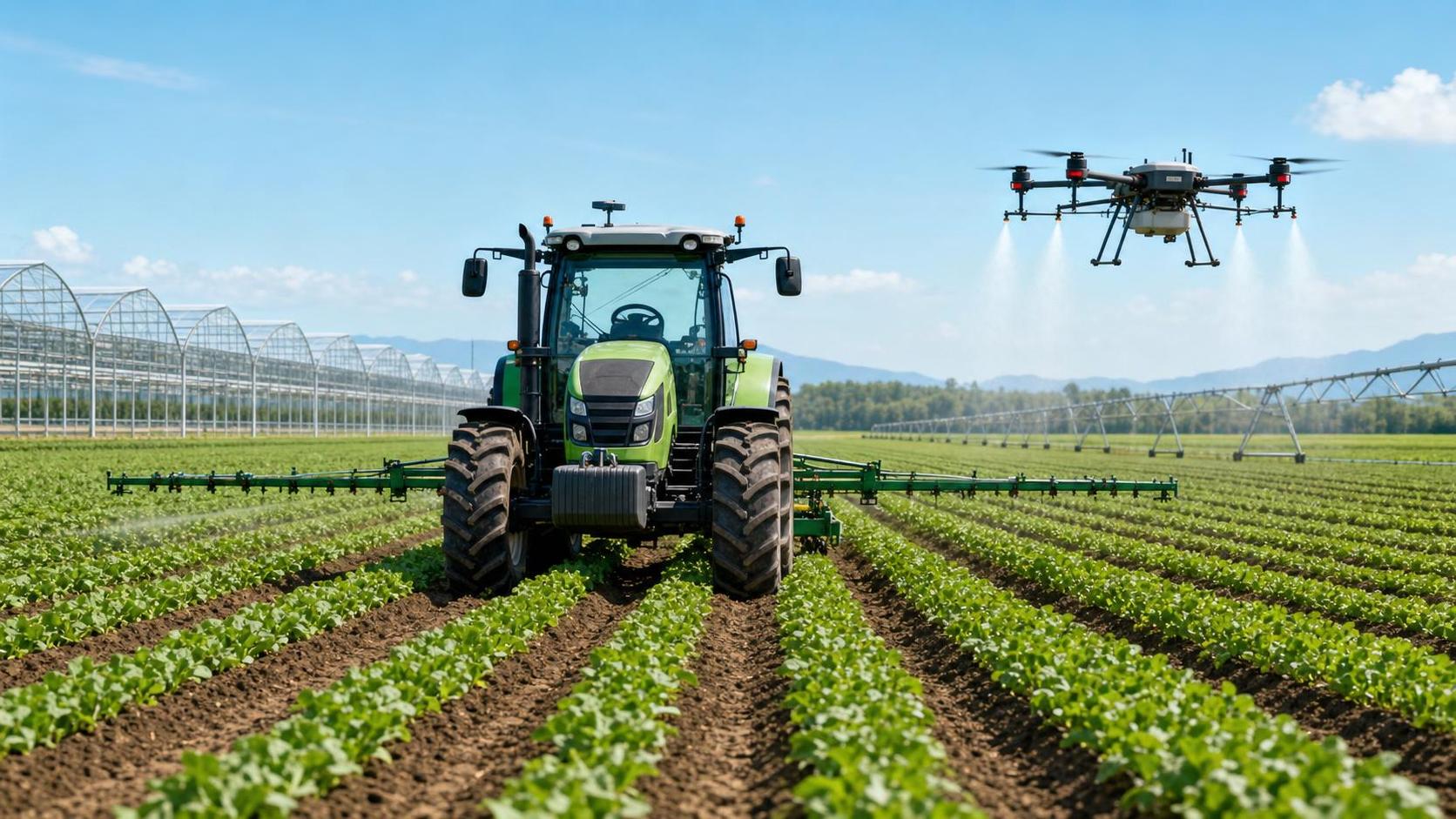
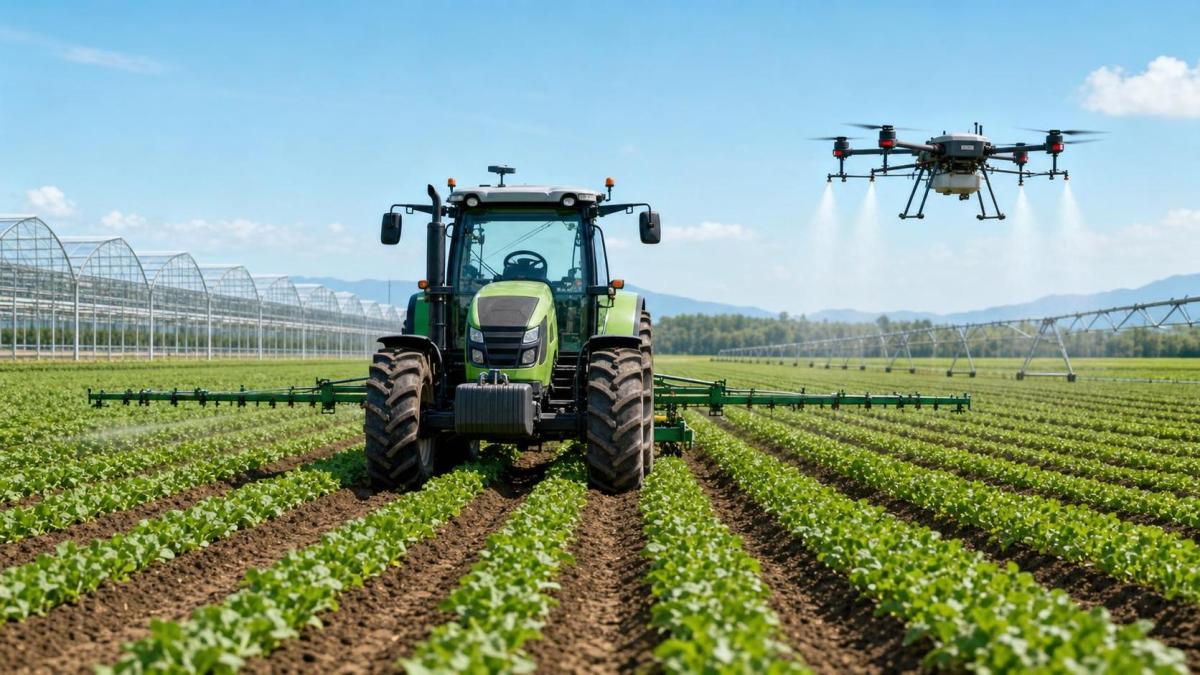
High-horsepower tractors remain one of the most practical climate-smart agriculture equipment investments for large-scale field operations.
The value comes from guidance accuracy, implement control, and reduced operator variability.
RTK autonomous steering can cut overlap in planting, spraying, and fertilizing.
That directly improves seed placement, fuel consumption, and chemical efficiency.
In dry years, precise passes matter even more because every missed or duplicated zone carries a heavier yield penalty.
What to evaluate
- RTK signal availability and correction subscription costs
- Compatibility with planters, seeders, sprayers, and digital farm platforms
- CVT transmission efficiency under variable load
- PTO performance for multiple implement types
- Dealer support, uptime guarantees, and software update policy
This category usually performs well when the farm already has scale, multiple passes, and rising labor pressure.
2. Precision agriculture drones for spraying and crop sensing
Precision drones are moving from pilot programs into serious procurement discussions.
That shift makes sense because drone-based climate-smart agriculture equipment is especially useful in uneven terrain and tight treatment windows.
Spraying drones can reduce water use, limit soil compaction, and improve access after rainfall.
When paired with multispectral imaging and NDVI maps, they also help identify stress before it becomes visible from the ground.
That supports variable-rate decisions and better input timing.
Best-fit use cases
- High-value crops with strict treatment timing
- Fields with access limitations after storms
- Operations targeting chemical and water efficiency
- Programs using prescription maps and digital scouting
The main caution is utilization rate.
If drone capacity is underused, the payback period can stretch quickly.
In actual procurement, buyers should model acres covered, refill time, battery workflow, and local regulations.
3. Smart irrigation and fertigation systems
Water risk is now central to most investment decisions.
That makes smart irrigation one of the most defensible climate-smart agriculture equipment categories available today.
The strongest systems combine flow control, soil moisture sensing, weather data, and fertigation management.
The result is tighter control over water application, nutrient delivery, and crop response.
This matters most where water pricing, drought exposure, or pumping costs are rising.
Buying signals that support investment
- Frequent over-irrigation or inconsistent zone performance
- High fertilizer loss or runoff concerns
- Need for auditable input records
- Expansion into greenhouse or controlled environment production
Well-designed systems do more than save water.
They improve consistency, which often has a bigger financial effect than raw volume reduction alone.
4. Greenhouse climate control and controlled environment agriculture systems
For protected cultivation, climate-smart agriculture equipment begins with environmental control.
Ventilation, heating, cooling, humidity control, CO2 dosing, and sensor networks all affect yield stability.
In volatile weather, greenhouse operators need equipment that responds quickly and reliably.
This is where automated control platforms outperform manual management.
They reduce climate swings, support water savings, and protect crop quality across seasons.
Priority evaluation points
- Sensor accuracy and calibration requirements
- Energy efficiency of heating and cooling equipment
- Integration with hydroponics and fertigation systems
- Alarm response, remote visibility, and redundancy design
For year-round production, this type of climate-smart agriculture equipment often justifies premium pricing through predictable output.
5. Livestock automation for feed, milking, and monitoring
Climate resilience is not only a crop issue.
Heat stress, labor shortages, and feed efficiency also shape livestock margins.
That is why livestock automation deserves attention as climate-smart agriculture equipment.
Feeding robots, TMR mixers, rotary milking systems, and sensor-based herd monitoring can improve consistency and reduce labor dependency.
They also create data that supports earlier intervention.
In practice, the investment case is strongest when labor turnover is high or herd management is expanding.
How to compare climate-smart agriculture equipment before buying
A useful comparison model should go beyond purchase price.
Climate-smart agriculture equipment should be tested against operational fit, integration value, and risk reduction.
This kind of framework keeps procurement decisions tied to business performance rather than marketing claims.
Final investment view
The best climate-smart agriculture equipment is not always the most complex system on the market.
It is the equipment that solves a clear operational constraint and keeps paying back under uncertain conditions.
For many operations, the strongest priorities are RTK-guided tractors, precision drones, smart irrigation, greenhouse climate control, and livestock automation.
Each represents a practical path toward lower waste, stronger output stability, and better capital efficiency.
A disciplined buyer should start with the biggest climate-related cost exposure, quantify the likely performance gain, and compare suppliers on uptime, compatibility, and service depth.
That approach turns climate-smart agriculture equipment from a trend purchase into a durable investment decision.
- high-horsepower tractors
- controlled environment agriculture
- livestock automation
- precision agriculture
- smart irrigation
- climate-smart agriculture
- precision agriculture drones
- RTK autonomous steering
- fertigation systems
- Feeding Robots
- controlled environment production
- CVT transmission efficiency
- climate-smart agriculture equipment
- controlled environment agriculture systems
Related Intelligence