
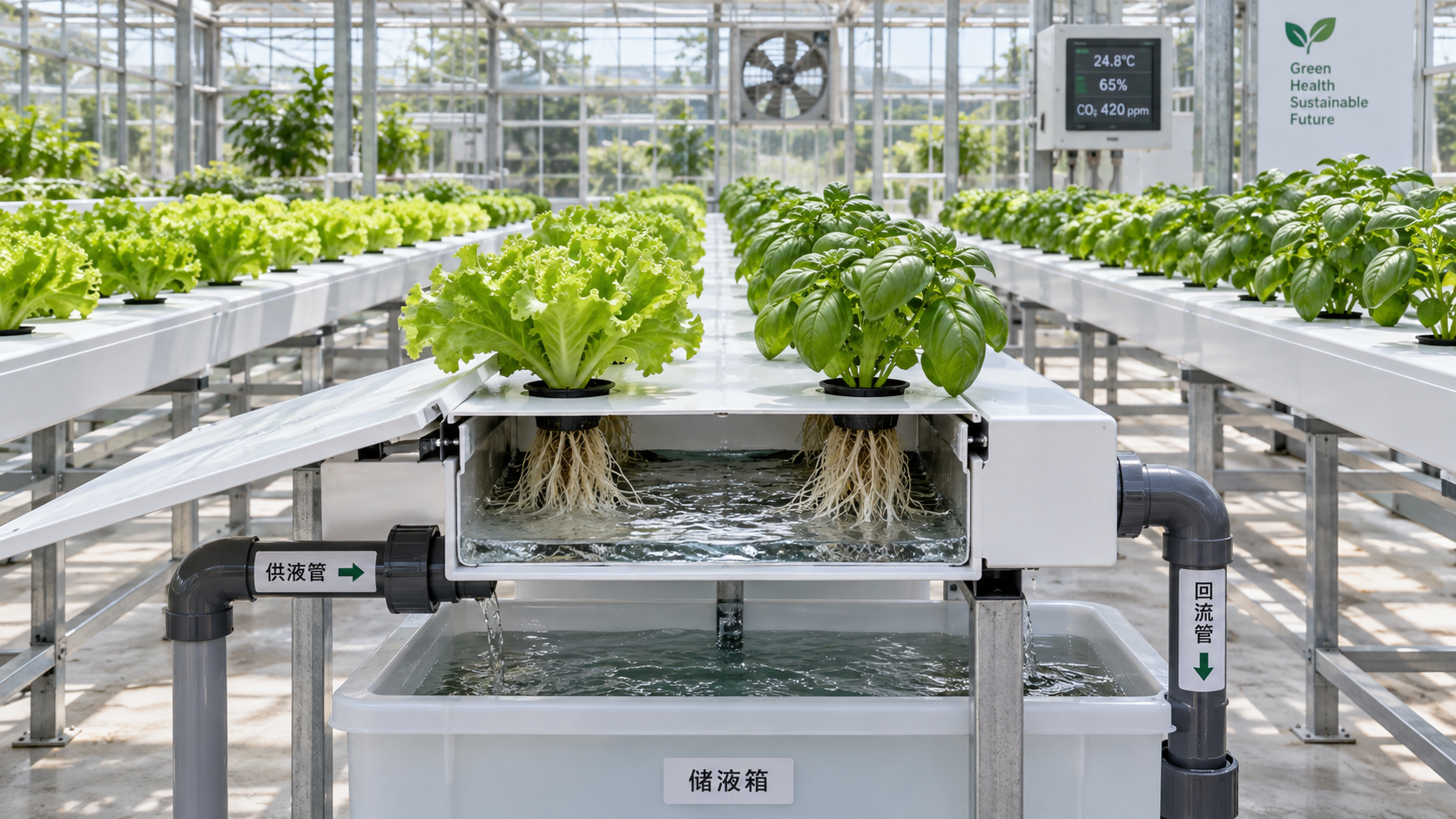
Use nutrient film technique when growing compact, short-cycle leafy greens or herbs, provided your operation can maintain reliable nutrient circulation, appropriate root temperatures, and rapid fault response.
For technical evaluators comparing controlled environment farming hydroponics options, NFT suitability depends on crop root characteristics, channel hydraulics, sanitation access, and resilience during equipment failures.
NFT sends a shallow, recirculating nutrient stream through channels, allowing roots to access both solution and air. Its limited water buffer makes circulation failures consequential.
This guide explains where NFT performs well, when alternatives deserve preference, and which engineering specifications and operating costs should determine procurement decisions before commercial deployment.
Which crops and operating conditions make NFT a good fit?
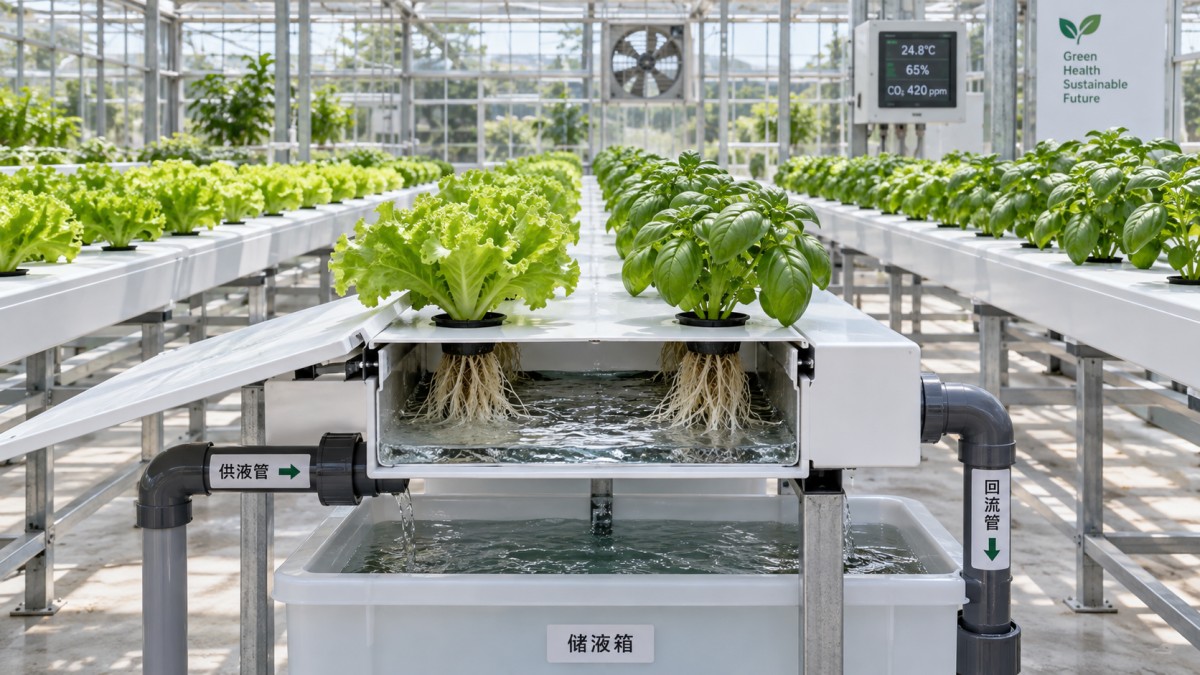
NFT is particularly suitable for lettuce, baby leafy greens, and selected culinary herbs when crop size, production schedules, and root growth remain predictable throughout cultivation.
Short production cycles help limit root accumulation inside channels. Uniform transplant quality also supports consistent hydraulic conditions and reduces variation in crop development across batches.
Basil and other herbs can perform well, but suitability depends on cultivar, harvest strategy, temperature requirements, and root growth during repeated cutting cycles over time.
Long-duration fruiting crops usually require different support and irrigation arrangements. Tomatoes and cucumbers generally suit substrate drip systems better because of their substantial root systems.
Strawberries require careful evaluation rather than automatic exclusion. Their longer residence time, crown placement, root health, and fruit hygiene create additional design and management demands.
Beyond crop selection, NFT fits facilities with dependable electricity, accessible channels, disciplined cleaning procedures, and operators who can respond promptly when circulation or environmental conditions deteriorate.
Its lightweight channels and relatively small circulating solution inventory can support bench layouts and vertical production. However, stacking introduces lighting, airflow, drainage, and maintenance challenges.
When should you choose another hydroponic system?
The useful comparison is operational: identify which system accommodates your crop and failure exposure at an acceptable total cost. Low initial equipment cost alone proves little.
Deep water culture provides a larger water reservoir around roots, which can buffer some circulation interruptions. It still requires adequate oxygen and a validated contingency plan.
Substrate systems can retain moisture around roots during short irrigation interruptions. Their actual buffer depends on substrate properties, container volume, crop demand, and irrigation strategy.
Favor alternatives when electricity interruptions are frequent, emergency response is slow, or mature roots repeatedly obstruct NFT channels under the intended production schedule and planting density.
If a supplier proposes NFT for an unfamiliar crop, request evidence from comparable commercial conditions, including full-cycle root development, marketable yield, and cleaning requirements between crops.
Which channel and nutrient-delivery specifications matter most?
Evaluate the complete hydraulic path: reservoir, pump, filtration, distribution manifold, individual channels, return piping, and drainage. A suitable pump cannot compensate for poorly balanced distribution.
Channel width, depth, length, slope, and internal profile must accommodate mature roots while maintaining nutrient movement. Published dimensions are starting points, not universal design requirements.
Some NFT designs use approximately one liter per minute per channel as an initial reference. Actual requirements depend on channel geometry, crop demand, and root mass.
Require suppliers to demonstrate flow at the installed operating head with realistic filter loading. Pump nameplate capacity does not establish delivery at the most distant channel.
Inspect inlet distribution and outlet drainage under mature crop conditions. Root mats can create ponding, preferential flow, or restricted returns that remain invisible during commissioning.
Adjustable supports and stable benches matter because sagging channels create low spots. Installation tolerances should remain acceptable after loading, thermal movement, and routine maintenance activities.
Confirm that reservoirs avoid overflow during shutdown and prevent pump starvation during operation. Include returning solution volume, minimum operating level, and cleaning access in sizing calculations.
Ask for removable covers or another practical method of inspecting roots and cleaning internal surfaces. Sealed, inaccessible channels can turn routine sanitation into expensive replacement work.
Can the system keep roots healthy as climate conditions change?
In controlled environment farming hydroponics, nutrient delivery and greenhouse climate control must work together. High radiation, warm air, and changing humidity alter transpiration and root demand.
Warm nutrient solution holds less dissolved oxygen while root and microbial respiration may increase. Consequently, acceptable performance during cool commissioning does not establish summer suitability.
Measure solution temperature and assess oxygen conditions at representative locations, including downstream channels. A reservoir reading alone may miss unfavorable conditions developing near mature roots.
Reservoir aeration can help, but it cannot correct every channel problem. Excessive root accumulation, ponding, and poor drainage still require physical or operational changes directly.
Set pH and electrical conductivity targets for the crop, growth stage, source water, and climate. Avoid treating one supplier's generic recipe as a universal operating standard.
Source-water analysis should cover alkalinity, relevant dissolved salts, and potential contaminants. These results influence acid demand, nutrient formulation, treatment requirements, and recirculation management over time.
Track nutrient additions, water replacement, and solution trends alongside crop performance. Stable conductivity does not prove that individual nutrients remain balanced throughout repeated production cycles.
Integrate irrigation alarms with climate data where useful. Rising solution temperature during high light deserves a different operational response from a brief sensor communication fault.
What happens when a pump, sensor, or power supply fails?
NFT roots have limited stored water outside the circulating stream. How quickly interruption becomes damaging depends on root development, temperature, humidity, airflow, and channel design.
Do not accept a universal safe outage duration. Establish an intervention window through supervised trials under representative conditions, with clear stopping criteria that protect crops.
Monitor actual delivery using appropriate flow or pressure measurements. A running pump motor does not prove that nutrient solution reaches channels after blockage or pipe failure.
Low reservoir level, lost flow, abnormal temperature, and dosing faults should produce actionable alarms. Specify who receives notifications, expected response times, and escalation during unattended periods.
Backup design may include standby pumps, automatic changeover, emergency power, and essential spare parts. Verify which controls and communication devices remain operational during a power outage.
Separate production into manageable hydraulic zones where practical. Isolation can reduce the crop area affected by a leak, treatment intervention, or localized equipment failure event.
During acceptance testing, simulate pump failure, interrupted power, blocked delivery, and sensor faults safely. Confirm detection, alarm delivery, changeover behavior, and recovery without uncontrolled nutrient dosing.
How much sanitation and maintenance capacity will NFT require?
Recirculation can distribute root pathogens through connected crops. Prevention therefore depends on clean planting material, suitable hygiene, monitoring, and a treatment strategy appropriate to the operation.
Filtration removes selected particles but does not automatically disinfect water. Any ultraviolet, thermal, or chemical treatment needs validated operating conditions and compatibility with nutrient management.
Plan cleaning around actual crop turnover. Evaluate how workers remove roots, open channels, wash surfaces, drain pipework, and verify cleanliness before the next planting cycle.
Ask suppliers to demonstrate cleaning on used equipment whenever possible. Labor estimates based on empty demonstration channels may exclude tangled roots, deposits, and difficult fittings.
Channel materials should tolerate intended cleaning agents and repeated handling. Check opacity, surface condition, dimensional stability, replacement availability, and documentation supporting suitability for the intended use.
Record maintenance hours per production area or harvested unit. This connects design accessibility to operating cost and makes comparisons more meaningful than broad automation claims.
How should technical evaluators calculate the business case?
Compare NFT and alternatives using marketable output under equivalent crop, lighting, and climate assumptions. Total fresh weight can conceal rejected plants, inconsistent sizing, and quality losses.
Include channels, supports, pumps, reservoirs, filtration, dosing, monitoring, installation, backup systems, and commissioning in capital expenditure. Identify shared greenhouse infrastructure separately to prevent misleading comparisons.
Operating costs should cover electricity, water treatment, nutrients, sanitation, labor, replacement components, and crop losses. In indoor farms, lighting and climate control can outweigh pumping costs.
Calculate cost per saleable kilogram by dividing annualized capital charges plus annual operating costs by annual saleable kilograms. Keep financing assumptions explicit and consistent between options.
Test sensitivity to selling price, labor rates, rejection rates, summer cooling demand, and interrupted production. A proposal that succeeds only at maximum yield needs closer examination.
Water recirculation can reduce discharge and freshwater demand, but savings depend on purging, cleaning, leaks, and source-water quality. Require clearly defined measurement boundaries for supplier claims.
Prefer a representative pilot over immediate expansion when crop suitability or local climate performance remains uncertain. Track several cycles, including the most demanding expected seasonal conditions.
What evidence should you require before approving NFT?
Request layout drawings, hydraulic calculations, pump duty points, material specifications, control descriptions, alarm logic, and cleaning procedures. Each document should correspond to the proposed installation.
Define acceptance criteria for channel delivery, drainage, sensor calibration, dosing safeguards, and backup operation. Agree on test methods and responsibilities before purchase orders become binding.
Require crop performance evidence that identifies cultivar, planting density, cycle length, environmental conditions, and rejection rates. These details determine whether reported results transfer to your facility.
Confirm access to spare pumps, compatible sensors, replacement channels, and technical support. Repair lead times matter when system performance depends on uninterrupted circulation throughout production.
Make the decision around crop fit and operational resilience
Choose NFT when compact crops, predictable root growth, accessible channels, and reliable circulation align with your production model. Its value depends on consistent saleable output.
Choose another system when greater root volume, moisture buffering, or simpler fault management better matches your constraints. Validate the final choice through measurable commissioning and crop trials.