
How does automation affect hydroponic fertigation system prices?
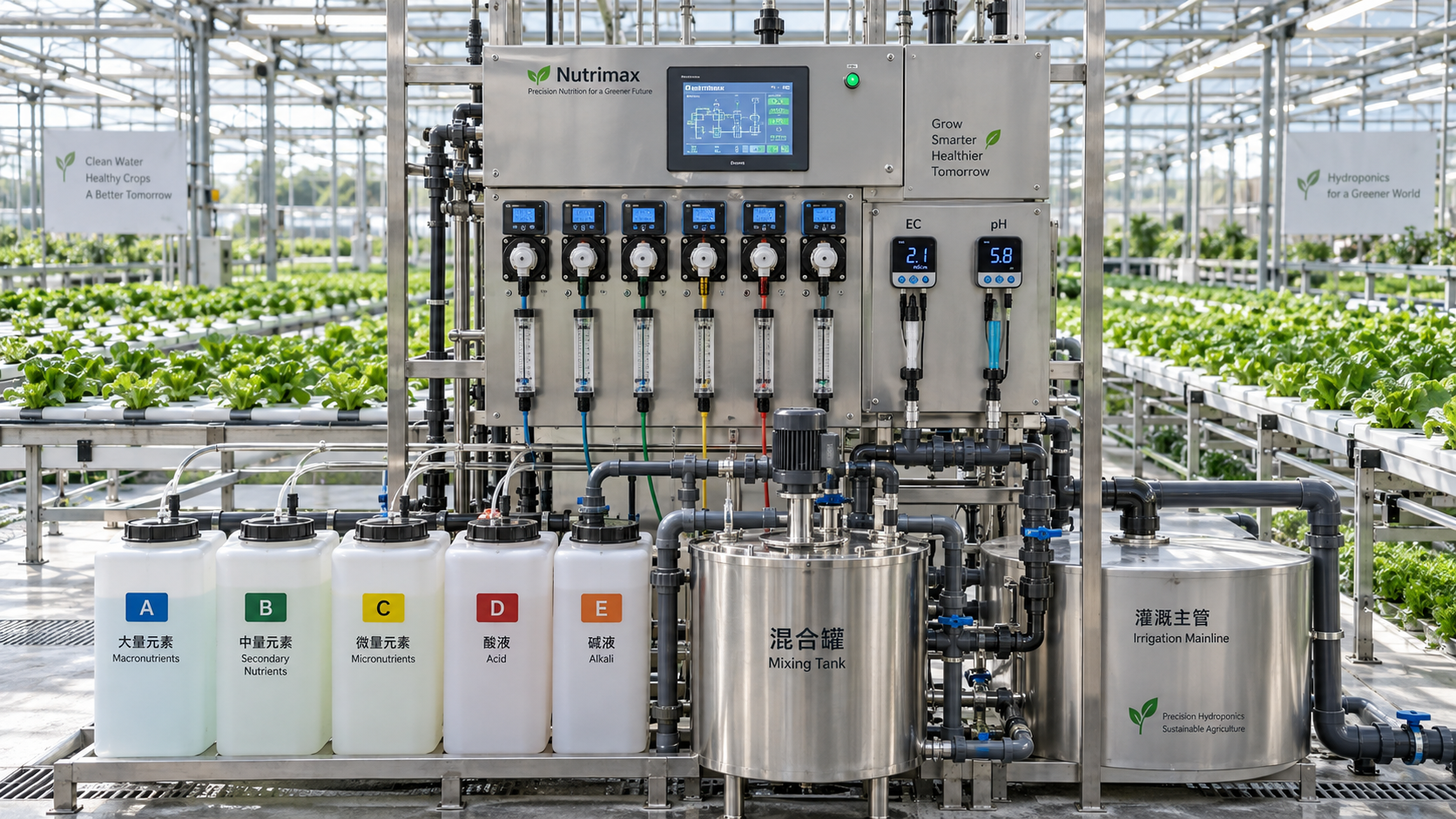
Automation raises the purchase price of a hydroponic fertigation system by adding sensors, dosing equipment, control software, and commissioning work. Whether that premium is justified depends on the work it replaces and the control the growing operation requires. A system serving one stable nutrient recipe has different requirements from an installation switching between crops, irrigation zones, and recycled drainage.
A meaningful hydroponic fertigation systems price comparison starts with a defined operating duty: water quality, required flow, nutrient recipes, irrigation frequency, and the consequences of an interruption. Without that baseline, a lower quotation can conceal missing equipment, while a higher quotation can include automation that adds little practical value.
Where the automation premium comes from
“Automated fertigation” covers several levels of functionality. A timer that starts irrigation is automated, but it does not necessarily measure nutrient concentration or correct acidity. A controller that adjusts dosing from sensor feedback performs a different job and requires additional hardware, configuration, and maintenance.
These levels are not a universal upgrade ladder. Proportional injection can be adequate where source water and operating conditions remain stable. Feedback control becomes more valuable when source water varies, recipes change frequently, or manual adjustment creates substantial work. Higher expenditure should correspond to a defined control requirement.
Dosing performance depends on more than the controller
The controller is only one part of the dosing system. Pump capacity, injector operating range, mixing volume, pipe layout, and sensor position determine whether a commanded adjustment produces the intended solution at the crop. An advanced interface cannot compensate for unsuitable hydraulics.
Maximum flow and minimum controllable flow deserve equal attention. Equipment sized for a large irrigation block may struggle to dose consistently when a small propagation zone runs alone. At low water flow, an oversized dosing pump can deliver stock solution in pulses that are difficult to mix evenly. The relevant specification is the supported operating range under the intended stock concentrations and pressures.
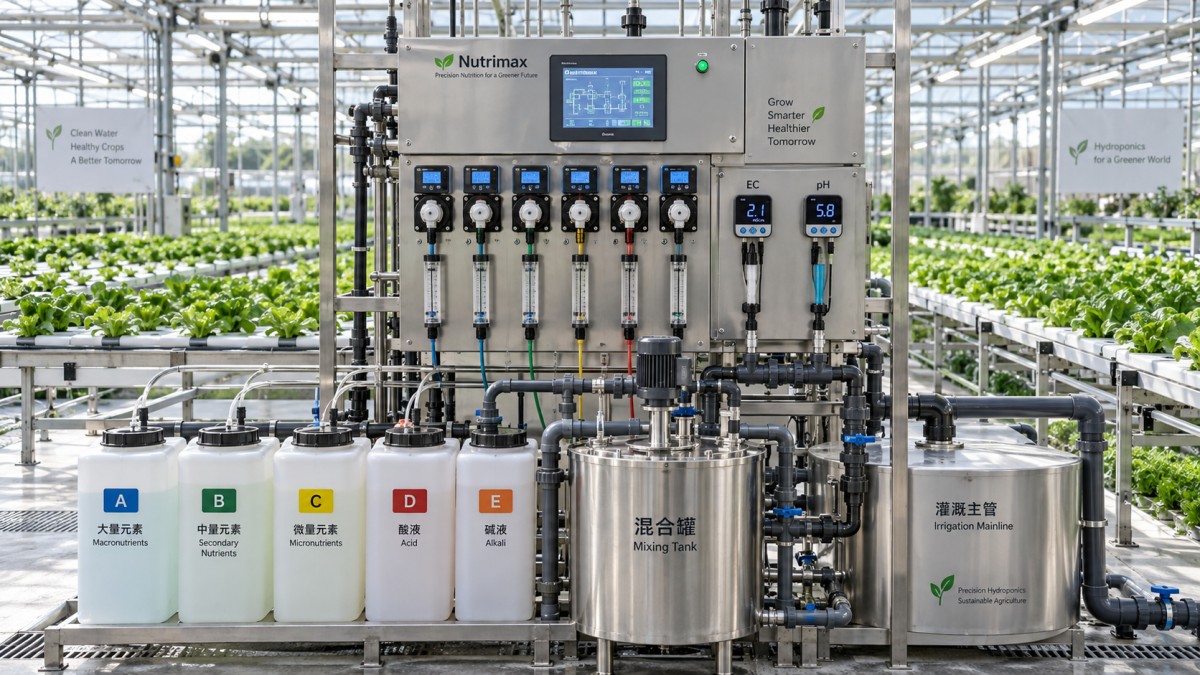
Separate nutrient channels also affect price. Concentrated calcium fertilizers generally require separation from concentrated phosphate or sulfate solutions to avoid precipitation. Additional recipes or individual nutrient adjustments can require more stock tanks, dosing channels, valves, and control outputs. A quoted channel count should distinguish nutrient channels from acid or alkali dosing.
EC measures overall electrical conductivity; it does not identify individual nutrient concentrations. A stable EC reading therefore cannot demonstrate that a recirculating solution retains the intended nutrient balance. Paying for tighter EC control does not remove the need for an appropriate water and nutrient monitoring program.
Likewise, source water pH alone does not establish acid demand. Alkalinity determines how strongly the water resists a pH change. Water analysis helps establish dosing capacity, chemical compatibility, and whether treatment is needed before the fertigation equipment. Those requirements can change the installed price substantially.
Zone count can hide a larger hydraulic requirement
A quotation describing support for many irrigation zones can appear more capable than it is. Valve control capacity does not establish how many zones can operate simultaneously, how many nutrient recipes are available, or how quickly the system can switch between them.
Sequential operation allows several zones to share a dosing unit, provided the irrigation window is long enough. Simultaneous operation requires sufficient pump output, pipe capacity, and dosing capacity. Different recipes needed at the same time can require separate mixing arrangements or additional dosing equipment.
Recipe changes also leave solution in tanks and pipework. Where crops require materially different formulations, the design must account for that residual volume and any flushing sequence. Otherwise, a software recipe change can occur well before the new solution reaches the emitters. Extra valves, routing, or dedicated lines increase cost but may be necessary for the intended separation.
Expansion claims need similar scrutiny. Spare controller outputs are useful only if the hydraulic equipment, electrical supply, communications, and software also support the planned expansion. The quotation should identify which additions require simple configuration and which require replacing major components.
The installed price is broader than the equipment price
A fertigation skid quotation can exclude work needed to make the system operational. Supply connections, filtration, electrical installation, drainage, stock tanks, chemical containment, and greenhouse distribution pipework all affect the final budget. Their scope should be explicit before competing totals are compared.
Automation adds commissioning tasks as well. Sensors need installation and calibration, dosing outputs need verification, and control settings need adjustment to the actual mixing and flow conditions. Remote access requires a working network connection and defined access permissions. Integration with existing climate controls requires compatible interfaces and agreement on which controller takes priority.
Retrofitting introduces particular uncertainties. Existing pipes may provide inadequate pressure at distant zones, old valves may lack suitable electrical interfaces, and limited plant-room space can complicate maintenance access. A site survey reduces the chance that an apparently straightforward controller upgrade becomes a broader installation project.
A closed-loop hydroponic installation adds another distinction: nutrient dosing and drainage recovery are separate functions. Collection tanks, return pumps, filtration, and any required water treatment should appear as identifiable items. Savings attributed to water recovery should only enter the financial calculation when the quoted scope actually enables that recovery.
Recurring costs change the value of automation
Automation reduces repetitive mixing and adjustment work, but it creates maintenance obligations. EC and pH probes need cleaning and calibration, with replacement according to condition and manufacturer guidance. Dosing pumps introduce wear parts such as tubing, seals, or diaphragms, depending on the design and chemicals involved.
The operating budget should include calibration solutions, replacement sensors, pump service parts, software subscriptions, and support. Installation details matter here: an accessible sampling assembly and serviceable dosing layout reduce the time needed for routine work. A low equipment price loses some appeal if a common replacement part requires a long shutdown or specialist attendance.
Software pricing deserves separate treatment. Remote viewing, alarm delivery, historical records, additional irrigation zones, and external data access may have different licensing terms. The quotation should state which functions remain available if a subscription ends or internet access fails.
Alarm capability also has value only when the system response is defined. An out-of-range reading could trigger a message, stop chemical dosing, interrupt irrigation, or invoke another configured action. The appropriate response depends on the crop and installation. Fault behavior should be documented for loss of water flow, empty stock tanks, invalid sensor readings, and power recovery.
Calculate the automation premium against measurable savings
The useful investment figure is the difference between two complete, workable alternatives. Comparing an automated installation with an incomplete manual equipment list exaggerates the premium; comparing it with an inefficient manual process can exaggerate the savings.
Incremental annual net benefit = avoided labor cost + demonstrated input savings + other supportable operating savings − additional annual automation costs.
Simple payback then equals the additional installed investment divided by that annual net benefit. The calculation requires a positive net benefit and does not capture financing, equipment life, or the timing of major replacements. A longer investment appraisal should include those factors.
Labor estimates should start with actual tasks and frequency: mixing stock solutions, measuring EC and pH, adjusting recipes, recording readings, and responding to deviations. Deduct the time still required for calibration, cleaning, stock preparation, and fault handling. Time released for other work is an operational benefit, but it becomes a cash saving only when paid hours, overtime, or external service expenditure actually falls.
Nutrient and water savings need an identifiable mechanism. Better dosing control can reduce overfeeding caused by inconsistent manual adjustment. Scheduling linked to suitable crop or substrate measurements can reduce unnecessary irrigation. Neither outcome follows automatically from installing a connected controller. Baseline consumption and the proposed control change must support the estimate.
Yield gains are less suitable as a default payback assumption because crop response also depends on climate, root-zone conditions, disease pressure, and management. Where local evidence is unavailable, a useful comparison separates measurable operating savings from potential crop benefits. This shows whether the investment remains acceptable without assigning an unsupported value to improved production.
Make the quoted performance testable
A useful specification describes performance at the delivery point, under defined conditions. Sensor accuracy alone says little about the EC or pH actually supplied during irrigation. Mixing delay, transport time, dosing response, and changing flow all influence the result.
Acceptance criteria should therefore cover representative operating situations, including the smallest irrigation zone, expected peak demand, and a recipe change. The measurement location, allowable variation, stabilization period, stock concentrations, and source water conditions need agreement before testing. Limits should reflect the crop requirement and the proposed system’s documented capability.
- Scope boundaries: identify responsibility for water treatment, distribution pipework, electrical work, network setup, and commissioning.
- A functional demonstration should include loss of flow and an invalid sensor signal, with the resulting dosing and irrigation behavior recorded.
- Replacement part availability and support response arrangements matter most where one dosing unit serves the entire growing area.
- Data access: specify ownership, export formats, and any charges for obtaining operating records or connecting another control system.
The defensible automation premium is the amount required to deliver the specified dosing, scheduling, and fault response under real operating conditions. A quotation becomes much easier to judge when those capabilities have an installed cost, an ongoing service cost, and an agreed method of verification.
Related Intelligence