
Can Hydroponic Systems Use Hard Water Without Clogging?
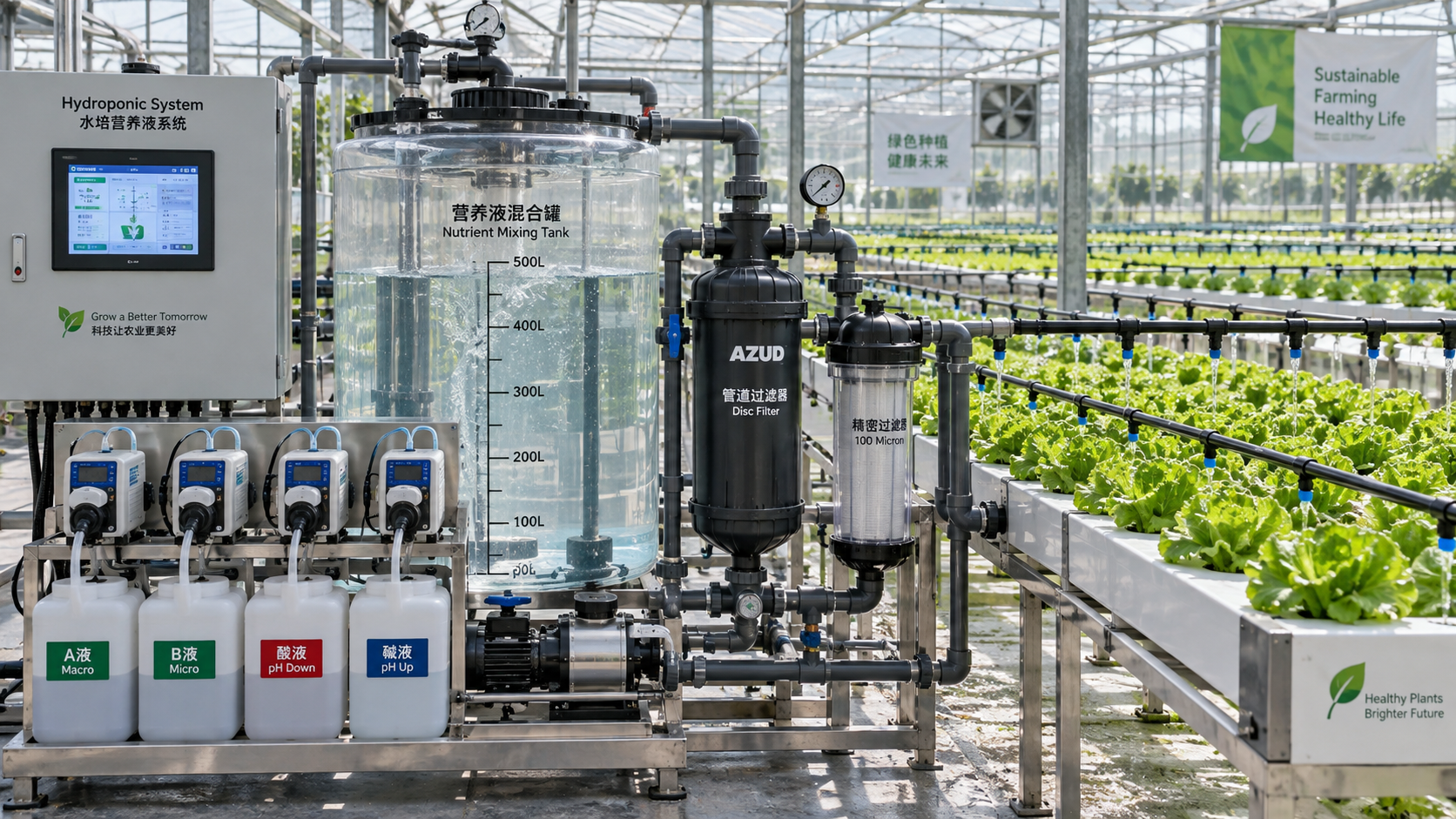
Yes—hydroponic systems can use hard water without persistent clogging, but only when the water chemistry, nutrient formulation, and irrigation hardware are compatible. Hardness alone does not determine whether a system will block. The more useful questions are how much alkalinity the water contains, which minerals it supplies, and whether those minerals will precipitate after fertilizer is added.
A sediment filter cannot remove dissolved hardness, and lowering pH does not remove calcium or magnesium. Reliable operation therefore requires a distinction between particle removal, alkalinity control, and mineral reduction. Some water supplies need only nutrient adjustments and controlled acid dosing; others justify blending with reverse-osmosis water. No treatment eliminates the need to monitor delivery performance.
Why does hard water clog some hydroponic systems but not others?
Hard water contains dissolved calcium and magnesium. These are essential plant nutrients, so their presence is not inherently harmful. Clogging starts when dissolved constituents form insoluble deposits, or when other contaminants accumulate in narrow passages.
Calcium carbonate scale becomes a concern when calcium and carbonate chemistry favor precipitation. High alkalinity, increasing pH, warming, evaporation, and carbon dioxide loss can contribute to that condition. Deposits may develop on tank surfaces, pumps, valves, emitters, and spray nozzles.
Fertilizer creates additional compatibility risks. Calcium can precipitate with phosphate, particularly at elevated pH or where concentrated solutions meet before adequate dilution. Calcium sulfate can also precipitate at sufficiently high concentrations. A water supply that remains clear in storage may therefore produce deposits after nutrient injection.
Not every blockage is mineral scale. Sand, iron deposits, microbial slime, algae, and root fragments can obstruct the same equipment. Treating all clogging as a hard-water problem can lead to unnecessary membrane treatment while the actual cause remains unresolved.
What is the difference between hardness, alkalinity, and pH?
These measurements describe different properties and should not be used interchangeably.
Two sources with the same pH can require very different amounts of acid because their alkalinity differs. Similarly, two sources with comparable hardness may behave differently if their bicarbonate, sulfate, phosphate, or sodium concentrations differ.
Hardness and alkalinity may both appear on a laboratory report as “mg/L as CaCO₃.” That shared reporting convention does not mean they measure the same thing. It also does not represent the actual calcium concentration available to the crop.
Which water tests are needed before choosing treatment?
A useful source-water analysis includes calcium, magnesium, alkalinity, pH, EC, sodium, chloride, sulfate, iron, and manganese. Suspended solids or turbidity measurements help identify filtration needs. Boron can also matter where groundwater composition or crop sensitivity warrants testing.
The sample should represent the water entering the nutrient preparation system. If storage, blending, or existing treatment changes its composition, test that water as well. Retesting is appropriate when a well, municipal supply, or seasonal source changes materially.
For clogging decisions, connect the report to operating conditions:
- Assess calcium and magnesium against the intended nutrient recipe.
- Use alkalinity to determine acid demand rather than selecting an arbitrary dose from pH alone.
- Check sodium and chloride because acceptable hardness does not guarantee acceptable salinity.
- Evaluate iron and manganese separately; their deposits require different treatment logic from carbonate scale.
- Consider temperature, concentration through recirculation, and the smallest flow passages in the system.
A mixing trial using the actual source water and intended working-strength nutrient solution can reveal cloudiness or sediment. It is a useful compatibility screen, not proof of long-term reliability: slow deposition and localized precipitation inside injectors may not appear in a short trial.
Can filters prevent mineral clogging?
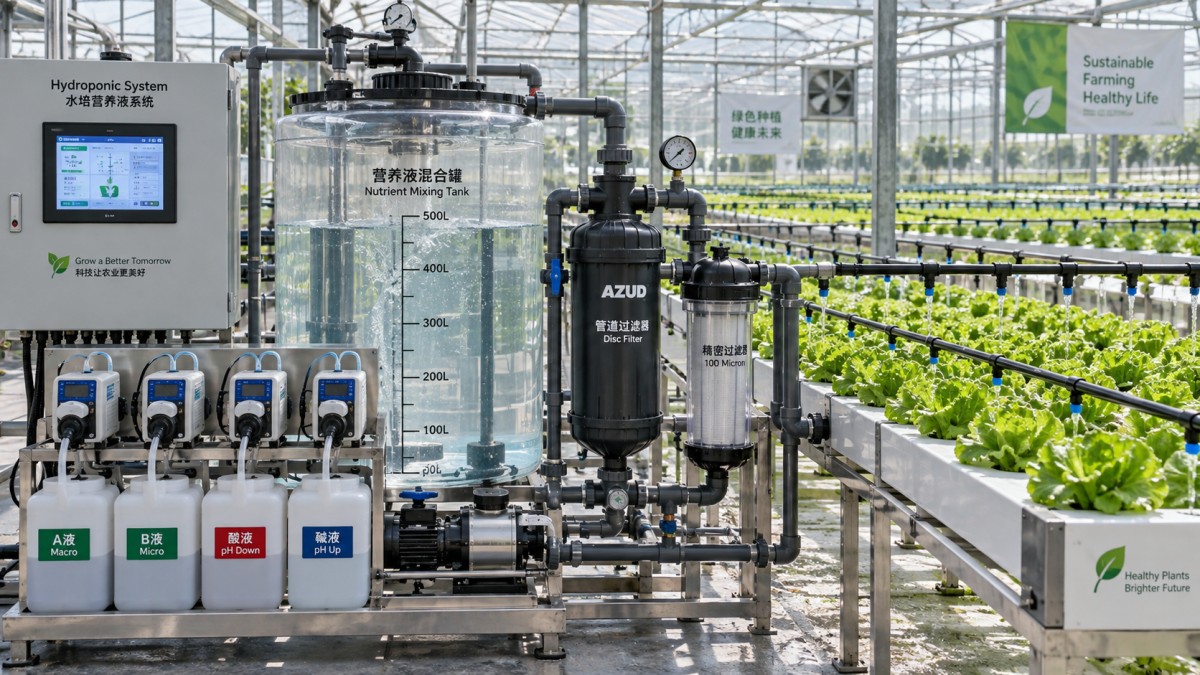
Filters can intercept suspended particles and some precipitates that have already formed. They cannot remove calcium, magnesium, or bicarbonate while those substances remain dissolved. A finer filter therefore does not solve a dissolved-mineral problem.
Filter selection should follow the emitter or nozzle manufacturer’s requirements, including the specified filtration rating and operating flow. Choosing an excessively fine filter without adequate capacity can create pressure loss and frequent cleaning without reducing scale formation downstream.
Filter placement also matters. Solids introduced through return water may require treatment separately from incoming source water. If precipitation occurs after fertilizer injection, an upstream filter cannot intercept it. A downstream filter may capture some particles, but the underlying chemical incompatibility still needs correction.
Track pressure differential across filters alongside flow and downstream pressure. Increasing differential pressure suggests loading within the filter; declining emitter output with a clean filter points toward a different restriction or hydraulic problem.
When is acid dosing sufficient?
Acid dosing is appropriate when excessive alkalinity is the main problem and the remaining dissolved ions fit the nutrient and salinity budget. Acid neutralizes bicarbonate alkalinity and can reduce carbonate-scaling risk. It does not remove calcium, magnesium, sodium, or chloride.
The acid requirement should come from measured alkalinity, the desired residual buffering capacity, and the acid’s concentration. A crop-specific root-zone pH target is a separate consideration. Removing all buffering is not automatically beneficial: low-alkalinity water can become susceptible to rapid pH changes.
Acid selection also affects nutrient formulation. Nitric acid contributes nitrate, phosphoric acid contributes phosphorus, and sulfuric acid contributes sulfate. Those additions must be included in the recipe. Phosphoric acid requires particular care where calcium concentrations and local mixing conditions could encourage calcium phosphate precipitation.
Automated dosing needs sufficient mixing time, calibrated sensors, flow interlocks, and protection against overdosing. A probe near the injection point may read an acid-rich pocket rather than representative water. Concentrated acids require compatible equipment, trained handling, and appropriate protective measures; dilution procedures should follow supplier instructions, including adding acid to water rather than water to concentrated acid.
When should reverse osmosis or blending be considered?
Reverse osmosis becomes more relevant when the source-water mineral load leaves insufficient room for a balanced fertilizer recipe, when sodium or chloride is excessive, or when alkalinity control alone cannot provide dependable operation. RO reduces many dissolved ions rather than simply changing their chemical form.
Full treatment is not always necessary. Blending untreated water with RO permeate can retain useful calcium and magnesium while lowering alkalinity and unwanted salts. The blend should be calculated from measured composition and verified, not selected only to achieve a convenient EC reading.
For example, an equal-volume blend with permeate containing very little of a given ion would approximately halve that ion’s source-water concentration before fertilizer addition. Actual permeate contains some residual ions, and source-water changes can alter the result.
RO introduces its own operating requirements: pretreatment, membrane scaling control, energy use, storage capacity, cleaning, and concentrate disposal. Where antiscalants or other treatment chemicals are used, suitability for the intended irrigation application and potential carryover should be reviewed. Low-alkalinity permeate also requires careful pH management and a nutrient recipe that replaces removed calcium and magnesium.
Is a conventional water softener a suitable alternative?
A conventional sodium-cycle softener exchanges calcium and magnesium for sodium. It can reduce hardness scale in equipment, but it does not meaningfully remove the source water’s alkalinity or overall dissolved-ion burden.
That trade-off can be unfavorable in hydroponics. Sodium contributes to EC without replacing calcium and magnesium nutritionally, and it can accumulate in recirculating systems. A water supply that becomes less scale-forming may become less suitable for crop production.
Softening is therefore not equivalent to RO. Specialized treatment arrangements may have a role, including pretreatment for particular membrane systems, but the final irrigation water must be assessed by its complete ion composition rather than its softened-water label.
Does system design change the risk?
Yes. Fine misting nozzles and small emitter passages are less tolerant of deposits than larger-flow channels. Aeroponic equipment consequently demands especially consistent water treatment and filtration. Drip systems depend on emitter geometry, filtration, pressure control, and effective lateral flushing.
Nutrient film technique and deep-water culture avoid some small delivery restrictions, but they are not immune. Scale can affect pumps, distribution manifolds, sensors, and aeration equipment. Open channels can also accumulate biofilm and root debris.
Recirculation adds another variable. Plants remove water and ions at different rates, so the return solution does not retain the original nutrient proportions. Sodium, chloride, or excess nutrients may accumulate even when EC appears manageable. Source-water suitability must therefore be evaluated over the operating cycle, not only at reservoir filling.
Hydraulic design should provide accessible filters, sampling locations, flush points, and replaceable components. These features do not prevent precipitation, but they make deterioration easier to detect and correct before delivery becomes uneven.
How should nutrient preparation change when using hard water?
Count source-water calcium and magnesium toward the nutrient formulation. Adding a standard recipe without that adjustment can create an unintended excess, although reducing a calcium-containing fertilizer may also reduce nitrate and require compensation elsewhere.
Keep incompatible concentrated stocks separate. Calcium-containing concentrates should not be combined with concentrated phosphate or sulfate solutions. Separate stock tanks reduce this risk, but injection points must still provide adequate dilution and mixing before incompatible streams meet.
A fertilizer marketed for hard water may be useful, but its label does not establish compatibility with every source. Its nutrient balance and acidifying effect need to match the actual analysis. Working-strength pH and EC measurements are essential checks, yet neither confirms that individual nutrient concentrations are correct.
What maintenance prevents small deposits from becoming failures?
Establish baseline pressure, flow, and representative emitter output when the system is clean. Compare subsequent measurements under similar operating conditions. Reservoir pH alone cannot show whether individual delivery points are becoming restricted.
Maintenance intervals should reflect measured loading and performance rather than a universal calendar. Flush laterals with enough flow to carry loosened solids out, clean filters according to pressure differential and manufacturer guidance, and inspect deposits when output declines. Mineral, biological, and mixed deposits require different cleaning approaches.
Acid cleaning should follow component compatibility limits and equipment instructions. It can dissolve carbonate scale but may damage unsuitable seals, metals, or coatings, and loosened material can obstruct downstream passages. Cleaning solutions should be isolated from crops unless the procedure is explicitly designed for crop-contact use. Never mix acids with chlorine-based cleaners because hazardous gas can be released.
The practical acceptance criterion is stable nutrient delivery: compatible solution chemistry, controlled root-zone conditions, and maintained distribution uniformity. Hard water is usable when those conditions can be sustained at a reasonable treatment and maintenance burden—not merely when a newly filled reservoir looks clear.
Related Intelligence