
EU Tightens Venlo Greenhouse Import Filings
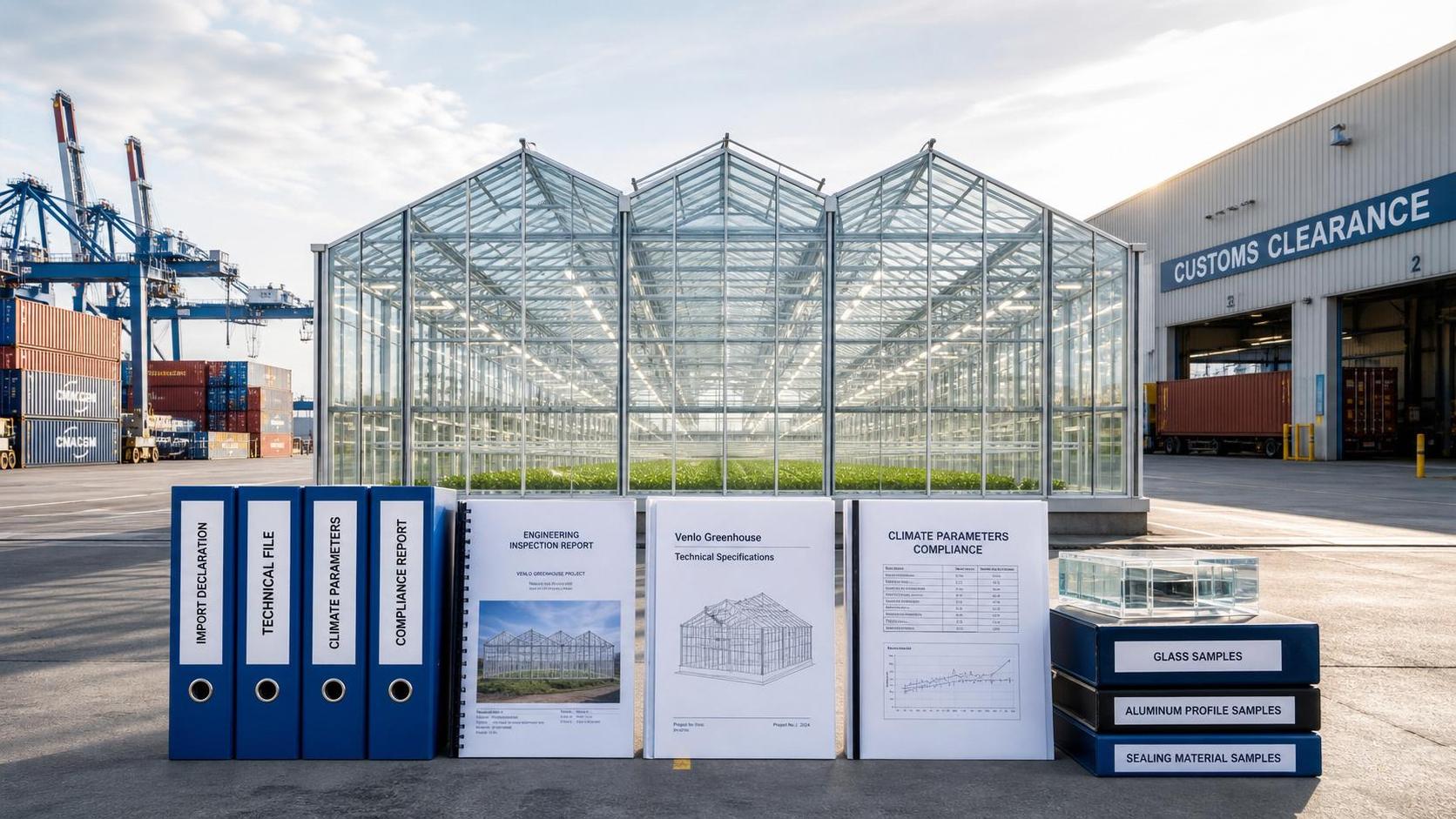
On December 1, 2026, a revised EU rule begins to change how Venlo Glass Greenhouses are declared for import: filings must now include a local climate adaptation parameter package tied to the product category, and the issue is immediately relevant for exporters, compliance teams, engineering documentation staff, import-side coordinators, and buyers managing CE review timelines. The development matters because it shifts part of market access from product description alone to a more demanding technical documentation package.
What the revised rule now requires
The European Commission issued the revised EC Regulation 2026/1128 on July 9, 2026. Under the revision, from December 1, 2026, all import declarations for Venlo Glass Greenhouses must be submitted together with a local climate adaptation parameter package.
According to the provided information, that package must include a wind load simulation report, localized calibration values for snow load, and measured summer ventilation heat load data. If these materials are not submitted, CE marking re-review will not proceed.
The requirement is directly linked to the Venlo Glass Greenhouses classification. The provided information also states that this will significantly increase the technical document delivery complexity faced by Chinese exporting companies.
Where the pressure is likely to appear first
Export filing and documentation teams
From an industry perspective, the most immediate impact is likely to fall on companies directly handling export declarations for Venlo Glass Greenhouses. The reason is straightforward: the filing package is no longer limited to ordinary product-related materials, but must now be accompanied by a climate adaptation set of technical parameters. The pressure is likely to appear in document completeness, internal review steps, and submission timing.
Manufacturers coordinating engineering data
Analysis shows that manufacturing enterprises may be affected through the preparation and organization of technical inputs. The required package includes simulation, localized calibration, and measured operational data, which means the business focus may shift toward whether engineering, testing, and document teams can assemble materials in a form suitable for import-side use. What deserves closer attention is the handoff between product design information and compliance submission materials.
Import-side buyers and project coordinators
Buyers, import coordinators, and project-facing teams may also feel the effect because CE re-review is explicitly tied to whether the parameter package is attached. Observably, this creates a practical concern around project scheduling, customs preparation, and communication over documentation readiness. Even where the commercial transaction remains unchanged, the pace of acceptance procedures may depend more heavily on technical file completeness.
Service providers supporting cross-border delivery
Supply chain and compliance service providers may see increased involvement in document checking, submission coordination, and communication between exporter and importer. The likely impact is not necessarily a change in product demand, but a change in how much procedural support is needed before a shipment can move through the required review path.
What companies should monitor now
Whether official wording receives further clarification
Analysis shows that companies should closely track any subsequent official wording, interpretive notes, or procedural clarifications related to the revised EC Regulation 2026/1128. The current rule already identifies the required package components, but in practice businesses will need to watch how those items are described and checked during filing and CE re-review workflows.
Which product declarations fall under the named classification
What deserves closer attention is the classification link. The requirement is described as directly binding the Venlo Glass Greenhouses category, so businesses should focus on how their products are declared and categorized in actual trade documentation. This is especially relevant for teams managing mixed product lines or multiple greenhouse structures under different descriptions.
How documentation affects lead time and customer communication
Observably, the rule is not only a compliance issue but also a delivery-planning issue. Companies should pay attention to whether document preparation, verification, and transfer will extend fulfillment cycles. Client communication may need to address what materials are required for filing and what that means for review timing.
How internal and external data responsibilities are assigned
From an industry perspective, another practical point is responsibility mapping. Businesses involved in exporting Venlo Glass Greenhouses should review who is responsible for simulation data, localized calibration inputs, measured summer ventilation heat load records, and final document assembly. The policy signal and the operational workload are not the same thing, and that distinction matters in execution.
Why this reads as more than a routine filing update
Analysis shows that this development is better understood as a documentation-threshold change rather than a simple administrative adjustment. The requirement does not merely add another form; it ties import declaration and CE re-review to a package of localized technical parameters. That signals a higher expectation for product-specific and environment-specific substantiation within the Venlo Glass Greenhouses category.
It is more appropriate to understand this as an actionable short-term compliance change with longer-term signaling value. The short-term element is clear because the December 1, 2026 effective date creates an immediate operational requirement. The longer-term signal is that technical substantiation linked to local climate conditions may carry greater weight in market-access documentation for this category. At the same time, continued observation is still necessary because the provided information does not include further procedural detail beyond the rule summary.
How the market may best read this development
At this stage, the most grounded conclusion is that the revised rule raises the documentation bar for Venlo Glass Greenhouses entering the EU and makes technical file readiness a more visible part of trade execution. The practical consequence, based on the provided information, is increased complexity for exporters, especially those responsible for assembling and delivering complete compliance materials.
From an editorial perspective, this should not be overstated as a full restructuring of the sector, but it should not be treated as a minor wording change either. It is more appropriate to understand the update as a concrete compliance requirement with direct operational implications and with broader significance as a regulatory signal worth continued monitoring.
Basis of this article and points for continued verification
This article is based on the user-provided news title, event date, and event summary concerning the revised EC Regulation 2026/1128 and the new requirement for a local climate adaptation parameter package for Venlo Glass Greenhouses imports.
For this type of industry update, commonly relevant source categories may include official notices, enterprise disclosures, industry association information, authoritative media reports, and standards-related documents. However, a specific official source link was not provided in the input, so the exact source document and any later interpretive materials still need ongoing verification.
Further attention should remain on any subsequent official clarification of filing practice, CE re-review expectations, and the operational interpretation of the required parameter package components.
Related Intelligence